
Current Affairs 15th May 2026 Daily Current Affairs 2026
BRICS Reaffirms Two-State Solution in Israel-Palestine Conflict
The BRICS Foreign Ministers’ Meeting held in New Delhi ( May 2026) reaffirmed support for an independent Palestinian State based on the pre-1967 borders, with East Jerusalem as its capital. India also reiterated its traditional support for a “two-state solution” to resolve the Israel-Palestine conflict.
- Sharp disagreements, particularly between Iran and the United Arab Emirates, prevented the adoption of a joint declaration, leading instead to the release of a “Chair’s Statement and Outcome Document.”
- A similar deadlock had emerged during the BRICS Deputy Foreign Ministers and Special Envoys meeting held in New Delhi in April 2026, where both countries clashed over references to the US-Israel conflict involving Iran, with the UAE also expressing concerns over Iranian aggression.
Key Highlights of the BRICS Foreign Ministers’ Meeting
- Support for Palestinian Statehood: Reaffirmed support for the establishment of a sovereign, independent, and viable Palestinian State based on the internationally recognised pre-1967 borders, with East Jerusalem as its capital.
- Reiterated commitment to the two-state solution in accordance with international law, UN Security Council resolutions, and the Arab Peace Initiative.
- Position on Gaza Strip: Described the Gaza Strip as an inseparable part of the Occupied Palestinian Territory and called for the unification of Gaza and the West Bank under the Palestinian Authority.
- Both Iran and the UAE raised heavy objections to the wording of this transition of power.
- Maritime Security and West Asia: Emphasised the importance of maintaining safe and unimpeded maritime commerce through international waterways and protecting civilian infrastructure and lives.
- Acknowledged differing views among members regarding the situation in West Asia, especially concerning the Strait of Hormuz, the Red Sea, and the Bab-el-Mandeb Strait.
- India-Iran Strategic Corridor: Iran pitched Chabahar Port as a “golden gate” for India to access Central Asia, the Caucasus, and Europe.
- India-Russia Economic Guarantees: Russia assured India of uninterrupted energy supplies and mapping out deeper cooperation on the North-South Transport Corridor, nuclear energy, and payment settlements using national currencies.
Key Facts About the BRICS
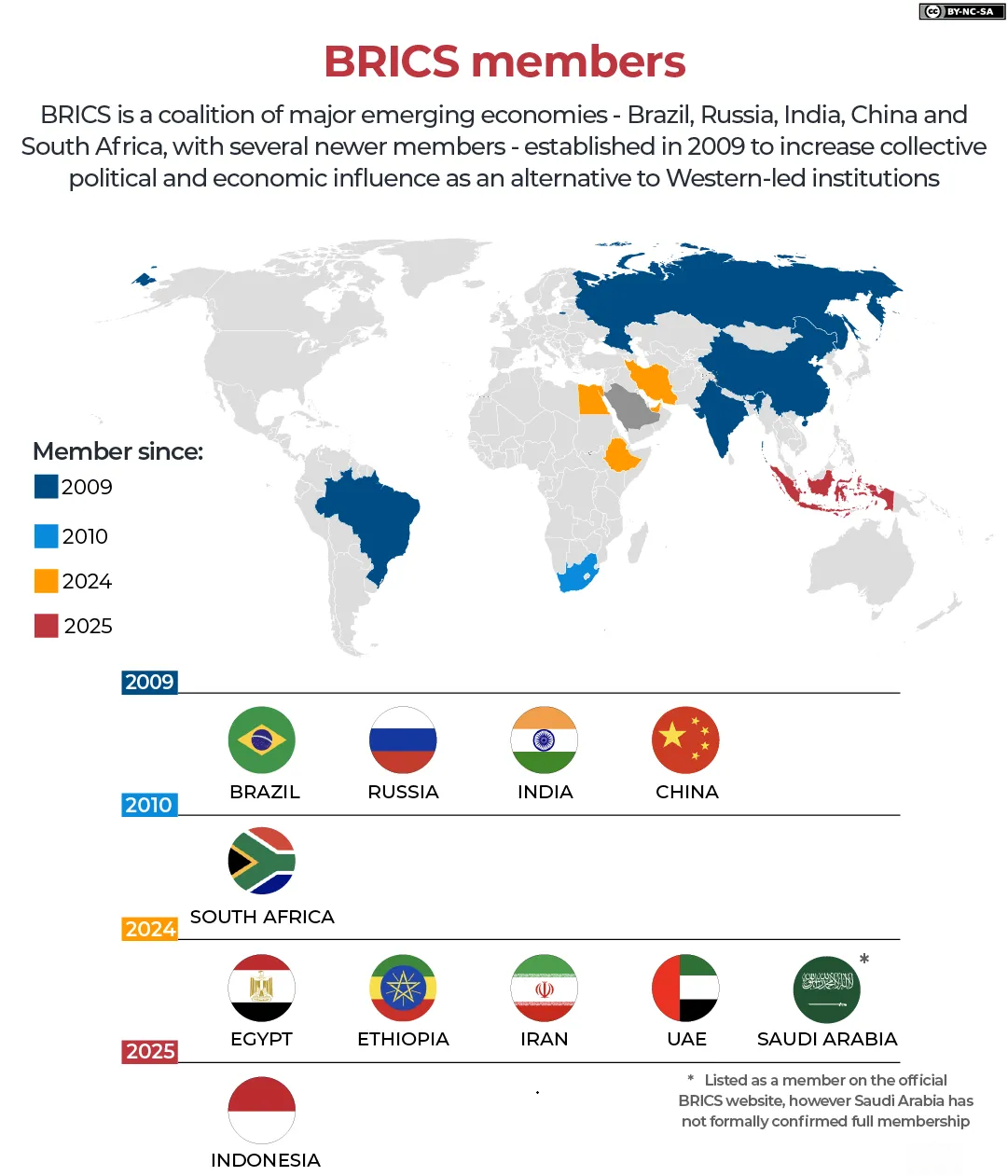
- BRICS: The term BRIC was coined by economist Jim O’Neill in 2001 to represent emerging economies – Brazil, Russia, India, and China.
- BRIC emerged as a formal grouping after leaders of Russia, India, and China met on the sidelines of the G8 Outreach Summit in 2006. It was institutionalized during the first BRIC Foreign Ministers’ meeting at the UNGA the same year, and the inaugural BRIC Summit was held in Yekaterinburg, Russia, in 2009.
- In 2010, South Africa formally joined the coalition, and the acronym was updated to BRICS.
- BRICS+: BRICS has expanded into BRICS+, now comprising its five original members, Brazil, Russia, India, China, and South Africa, along with newly inducted members: Egypt, United Arab Emirates, Ethiopia, Indonesia, and Iran.
- The bloc represents about 49.5% of the global population, 40% of global GDP, and 26% of global trade.
- Objective: It aims to reform global governance and provide alternatives to Western-dominated institutions like the IMF and World Bank.
- Chairmanship: BRICS operates through a rotating annual chairmanship and is based on three pillars: political and security, economic and financial, and people-to-people cooperation.
- It does not have a permanent secretariat or a formal charter.
- India’s 2026 BRICS Chairship is guided by the theme “BRICS: Building for Resilience, Innovation, Cooperation and Sustainability,” with a strong emphasis on a “Humanity First” approach.
- New Development Bank (NDB): Headquartered in Shanghai, China, it was established in 2015 by the BRICS countries as a multilateral development bank aimed at mobilising resources for infrastructure and sustainable development projects.
Two-State Solution
- About: The two-state solution is a proposed framework for resolving the Israeli-Palestinian conflict by establishing two separate, independent states: Israel for the Jewish people and Palestine for the Palestinian people.
- Historical Context: The concept traces back to the 1947 UN Partition Plan (Resolution 181), which proposed dividing Mandatory Palestine into independent Arab and Jewish states, with Jerusalem under an international regime.
- The Oslo Accords (1993) a landmark peace process where Israel and the Palestine Liberation Organization (PLO) officially recognized one another and established the Palestinian Authority (PA) as a transitional body for self-governance in parts of the West Bank and Gaza Strip.
- Core Issues Addressed: A successful two-state solution would require an agreement on several contentious issues:
- Borders: Most international consensus models, including those backed by the United Nations and India’s official foreign policy, advocate for borders based on the lines existing before the 1967 Six-Day War (often referred to as the Green Line), subject to mutually agreed-upon land swaps.
- Status of Jerusalem: Both sides claim Jerusalem as their historic capital. A standard two-state blueprint frequently envisions East Jerusalem as the capital of the future Palestinian state, while West Jerusalem remains the capital of Israel, or proposes a shared, internationally administered status for the holy city.
- Resolution of the Refugee Crisis: The framework requires a negotiated settlement regarding the “right of return” or compensation for millions of Palestinian refugees displaced during the 1948 and 1967 conflicts.
- Security: Ensuring the security of both the Israeli and Palestinian states.
Evolution of India’s Stance on the Israel-Palestine Issue
- Historically Pro-Palestine: India was the first non-Arab State to recognize the Palestine Liberation Organisation (PLO) as the sole and legitimate representative of the Palestinian people in 1974. In 1988, India recognized the State of Palestine.
- Establishing Ties with Israel: India established full diplomatic relations with Israel in 1992, balancing its historical support for Palestine with its growing strategic and defense ties with Israel.
- The ‘De-hyphenation’ Policy: In recent years, India has successfully “de-hyphenated” its relationship with Israel and Palestine.
- This means India treats its relations with both entities independently, without letting the relationship with one dictate the relationship with the other.
- Current Stance: While India strongly condemned the October 2023 terror attacks by Hamas and stood in solidarity with Israel against terrorism, it has continuously sent humanitarian aid to Gaza and firmly reiterated its long-standing support for a negotiated Two-State solution.
Geography of the Israel-Palestine Region
Core Territories
- Israel: Shares land borders with four countries: Lebanon (North), Syria (Northeast), Jordan (East), and Egypt (Southwest).
- It has a coastline on the Mediterranean Sea to the west and a tiny outlet to the Red Sea (Gulf of Aqaba) to the south.
- The West Bank: A landlocked territory. It is bordered by Israel to the north, west, and south, and by Jordan to the east.
- The West Bank does not touch the Mediterranean Sea or Egypt.
- The Gaza Strip: A narrow coastal strip. It is bordered by Israel to the north and east, the Mediterranean Sea to the west, and Egypt to the south.
- Gaza does not share a border with Jordan or the West Bank.
Disputed and Strategically Important Regions
- Golan Heights: A rocky plateau in the northeast. Israel captured it from Syria in the 1967 Six-Day War and later effectively annexed it. It overlooks the Jordan Rift Valley and the Sea of Galilee.
- Sinai Peninsula: A triangular peninsula belonging to Egypt, connecting Africa to Asia.
- Israel captured it in 1967 but returned it to Egypt under the 1979 Camp David Accords.
Crucial Water Bodies
- Mediterranean Sea: Forms the western coastline for both Israel and the Gaza Strip.
- Sea of Galilee (Lake Tiberias / Kinneret): Located in northern Israel, near the Golan Heights. It is the lowest freshwater lake on Earth and Israel’s primary freshwater reservoir. The Jordan River flows through it.
- Jordan River: Flows from north to south, passing through the Sea of Galilee and emptying into the Dead Sea.
- It forms the natural eastern boundary of the West Bank and Israel, separating them from Jordan.
- The Dead Sea: A hyper-saline lake bordered by Jordan to the east and Israel and the West Bank to the west. It is the lowest land elevation point on Earth.
- Gulf of Aqaba: Located at the southern tip of Israel. The Israeli port city of Eilat sits here, providing crucial access to the Red Sea (and thereby the Indian Ocean) without needing to navigate the Suez Canal.
Important Border Crossings
- Rafah Crossing: The sole crossing point between the Gaza Strip and Egypt (Sinai Peninsula). It is the only Gaza exit not directly controlled by Israel.
- Kerem Shalom Crossing: A major commercial crossing point situated at the junction of the Gaza Strip, Israel, and Egypt.
- Erez Crossing: The primary pedestrian crossing between the northern Gaza Strip and Israel.
Key Cities in News
- Jerusalem: A central, contested city situated in the Judean Mountains between the Mediterranean and the Dead Sea.
- The “Green Line” historically divided it into West (Israeli) and East (captured by Israel in 1967, claimed by Palestine).
- Ramallah: Located in the central West Bank, just north of Jerusalem. It serves as the de facto administrative capital of the Palestinian Authority (PA).
- Haifa: A major northern Israeli port city on the Mediterranean coast (strategic because the Adani Group recently acquired the Haifa Port).
Bharat Maritime Insurance Pool (BMIP)
Recently, the Department of Financial Services (DFS) launched the Bharat Maritime Insurance Pool (BMIP) to ensure uninterrupted maritime insurance coverage amid rising geopolitical risks linked to the West Asia crisis.
- Purpose: BMIP aims to provide a continuous and reliable stream of maritime insurance coverage for Indian shipping operations and reduce dependence on foreign insurers.
- Coverage: The pool covers hull, cargo, Protection & Indemnity (P&I), and war-related maritime risks for Indian-flagged or India-owned vessels, and cargo with origin or destination in India. It provides coverage of up to $1.5 billion per loss, backed by a sovereign guarantee of ₹12,980 crore.
- Management: General Insurance Corporation of India (GIC Re) has been appointed as the manager of the sovereign-backed BMIP. The pool has been established for an initial period of 10 years, extendable by another five years.
- Claim Mechanism: BMIP can service claims up to $100 million independently using internal reserves, member contributions, and reinsurance, while claims exceeding $100 million will invoke the sovereign guarantee as a last-resort backstop.
- Significance: With nearly 95% of India’s trade moving through maritime routes, BMIP is expected to reduce insurance costs, lower forex outflows, strengthen trade resilience and enhance India’s strategic autonomy amid geopolitical disruptions.
Financial Inclusion through DPI and AI
India is witnessing a paradigm shift in its financial inclusion journey, evolving from basic banking access to a sophisticated, technology-led ecosystem powered by the convergence of Digital Public Infrastructure (DPI) and Artificial Intelligence (AI).
How Technology is Leading Financial Inclusion in India?
- Foundation of JAM Trinity: The integration of Jan Dhan accounts (58.16 crore), Aadhaar (over 144 crore generated), and mobile connectivity (125.87 crore subscribers) has created a unique financial identity for citizens, ensuring geography is no longer a barrier to access.
- Expansion of Digital Rails: The Unified Payments Interface (UPI) has democratized payments, accounting for 81% of total retail payment volume, while Direct Benefit Transfer (DBT) has saved the government Rs 4.31 lakh crore by eliminating leakages.
- AI-Powered Linguistic Inclusion: Through the BHASHINI initiative, the RBI and Digital India BHASHINI Division (DIBD) are developing “Banking BHASHINI,” a domain-specific language model to provide financial services in all 22 scheduled Indian languages, removing literacy and language barriers.
- Regulatory Innovation: The RBI Regulatory Sandbox allows for testing fintech innovations like digital KYC and cybersecurity products, while MuleHunter.AI provides real-time detection of “mule” accounts to mitigate cybercrime.
- A mule account (or money mule account) is a bank or financial account used by criminals to receive and transfer funds obtained through illegal activities like phishing, investment scams, or drug trafficking.
- Empowering the Informal Sector: Mission Digital ShramSetu utilizes AI and Blockchain to dismantle structural constraints for 490 million informal workers, facilitating financial security and real-time skill verification.
- Frictionless Credit via ULI: The Unified Lending Interface (ULI) acts as a DPI for the lending space, using Application Program Interface (APIs) to assess creditworthiness through “digital footprints,” potentially unlocking a USD 130-170 billion credit gap for MSMEs.
- Consent-Based Data Sharing: The Account Aggregator (AA) framework enables secure, voluntary sharing of financial data across institutions, reducing documentation and accelerating loan approvals for over 252.9 million linked users.
- The Account Aggregator (AA) framework is a revolutionary DPI in India that allows individuals to share their financial data securely and digitally between different institutions (like banks, insurers, or tax authorities) with their explicit consent.
Digital Public Infrastructure (DPI)
- About:DPI refers to a shared, core digital network that enables countries to deliver vital public and private services to their citizens at a massive scale.
- Just as physical infrastructure—like highways, railways, and electrical grids—is essential for industrial growth, DPI serves as the invisible digital highway system necessary for a modern economy to function efficiently.
- 3 Pillars of DPI:
- Digital Identity: A secure, unique digital ID that verifies who a citizen is. This eliminates identity fraud, and ensures benefits reach the right person.
- Real-Time Payments: A fast, low-cost, interoperable payment network that connects banks, mobile wallets, and merchants.
- Data Exchange/Consent Layer: A secure architecture that allows individuals and businesses to share their personal data (like bank statements, medical records, or tax histories) with third-party service providers safely, digitally, and only with explicit consent.
- Core Characteristics of DPI:
- Interoperability: Systems (like UPI) communicate seamlessly across different platforms.
- Open Source/APIs: Prevents monopolies through open code.
- Scalability/Low Cost: Handles billions of transactions efficiently.
- PPP Model: Government builds and regulates the underlying tracks, while private players innovate consumer-facing apps on top.


