India-Nepal Border Frictions Regarding Kailash Yatra Route
Nepal has officially expressed “concerns” to both India and China regarding the upcoming Kailash Mansarovar Yatra being routed through the Lipulekh Pass.
- Kathmandu has reiterated its claim that the Kalapani-Limpiyadhura-Lipulekh region is part of Nepal’s sovereign territory, a stance India has firmly rejected.
What are the Differing Territorial Claims of Nepal and India?
- Nepal’s Standpoint: Nepal claims that the territories of Limpiyadhura, Lipulekh, and Kalapani (located east of the Mahakali River) have been integral parts of Nepal since the Treaty of Sugauli in 1816.
- India’s Rebuttal: India stated that Nepal’s claims are “neither justified nor based on historical facts and evidence.”
- India highlighted that the Lipulekh Pass is not a new development but has been a longstanding and traditional route for the Kailash Mansarovar Yatra since 1954.
- India argues the Kali River originates from springs further east, placing Kalapani within India’s Pithoragarh district (Uttarakhand), where it has maintained a military presence since the 1960s.
- Commitment to Dialogue: Despite the friction, India reiterated its willingness to engage in constructive interaction with Nepal to resolve agreed-upon boundary issues through bilateral diplomacy.
- In 2020, Nepal released a new political map incorporating Lipulekh, Kalapani, and Limpiyadhura, later reflected in a revised 100-rupee note.
- The same year, India’s construction of a road link through Lipulekh to Tibet drew strong objections from Nepal, which termed it a violation of its sovereignty.
- Both sides continue to rely on the Sugauli Treaty to support their claims, differing mainly over the origin point of the Mahakali River that defines the boundary.
- In April 2026, Nepal began strictly enforcing a rule requiring customs duty on goods worth more than 100 NPR carried across the border, aimed at curbing informal trade and protecting local traders.
- India termed it a pre-existing rule but sought assurances against harassment of civilians.
Key Facts About the Kailash Mansarovar Yatra
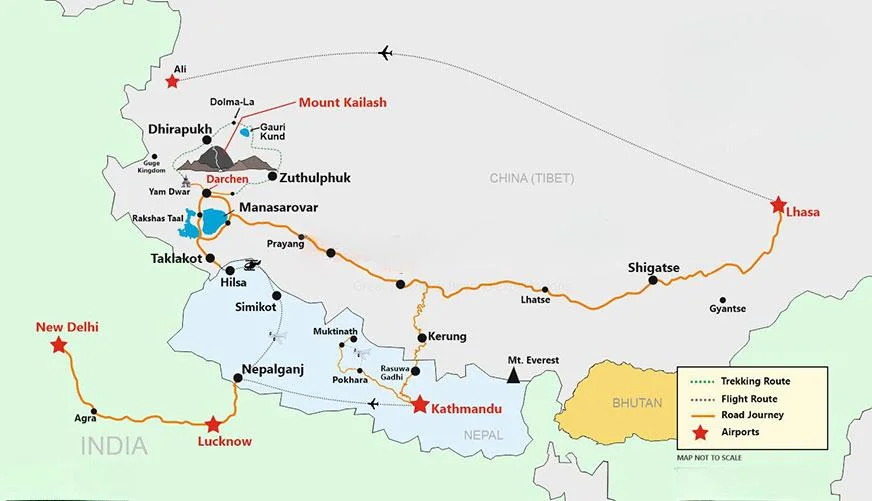
- About: Kailash Mansarovar Yatra is a pilgrimage organized by the Ministry of External Affairs (India) to Mount Kailash (6,638 m) and Lake Mansarovar (4,600 m) in the Tibet Autonomous Region (TAR) of China.
- The Kora (Parikrama) around Mount Kailash is a high-altitude trek, peaking at Dolma La Pass (~18,600 ft), and is physically demanding. Pilgrims also perform ritual bathing in Lake Mansarovar (~15,000 ft), one of the world’s highest freshwater lakes.
- Mount Kailash, though lower in height than Mount Everest (8,849 meters), remains unclimbed as its ascent is prohibited due to its sacred significance.
- Official Operational Routes:
- Lipulekh Pass (Uttarakhand): It is the shortest route to Mansarovar (50 km from the border), but rough terrain extends the trek to 200 km.
- It was the first Indian border post opened for trade with China in 1992, followed by Shipki La (1994) and Nathu La (2006).
- Nathu La Pass (Sikkim): This 1,500 km fully motorable route (it is one of the world’s highest motorable roads) opened in 2015; easier for pilgrims, no trekking needed.
- Nathu La connects Sikkim with China’s TAR and is part of the ancient Silk Road.
- Lipulekh Pass (Uttarakhand): It is the shortest route to Mansarovar (50 km from the border), but rough terrain extends the trek to 200 km.
- Mount Kailash: It is a diamond-shaped black rock peak in Tibet, sacred to Hindus, Buddhists, Jains, and Bons, and is the source of major Asian rivers like the Brahmaputra, Sutlej, Indus, and Karnali.
| Religion | Significance of Mount Kailash |
| Hinduism | Mount Kailash is the abode of Lord Shiva and Goddess Parvati; seen as the spiritual center of the universe. A dip in Lake Mansarovar is believed to cleanse sins. |
| Buddhism | Known as Kang Rinpoche (“Precious Jewel of Snow”); believed to be the abode of Demchok, symbolizing supreme bliss. |
| Jainism | Referred to as Mount Ashtapad; sacred as the site where Rishabhanatha attained moksha. |
| Bon | Called the “Nine-Story Swastika Mountain”, regarded as a mystical axis mundi (center of the world) in the indigenous Bon religion. |
- Physical Challenges: The high-altitude pilgrimage poses serious risks like Acute Mountain Sickness (AMS), extreme terrain, making rigorous medical screening essential before undertaking the journey.
Mission Drishti: World’s 1st OptoSAR Satellite
The Indian space start-up GalaxEye, successfully launched its debut satellite, Mission Drishti, aboard a SpaceX Falcon 9 rocket, marking a global milestone in simultaneous multi-sensor earth observation. Weighing 190 kg, Mission Drishti is India’s largest privately developed Earth observation Satellite.
- Opto-SAR Technology: Drishti is the world’s first satellite designed to capture both optical (multi-spectral) and Synthetic Aperture Radar (SAR) images of the same location at the same time.
- Solving the Tropical Cloud Cover Problem: Traditional optical satellites cannot see through clouds or at night, a major issue for tropical countries like India; Drishti’s SAR sensors penetrate clouds while the optical sensors provide intuitive clarity, offering all-weather, day-and-night imaging.
- When clouds obstruct the view, the satellite employs Artificial Intelligence (AI) to regenerate optical-like images from the SAR data, making the information accessible to non-experts.
- Simultaneous Synchronization: The satellite uses a proprietary technology stack that synchronizes the optical and SAR sensors, which typically capture images from different angles. This ensures data fusion happens instantly, without the need for manual alignment of separate datasets, a key innovation of Drishti.
- Strategic Utility: It supports border surveillance, defence, disaster response, agriculture, infrastructure planning, and insurance assessment, as radar imaging bypasses cloud cover during floods, cyclones, or landslides.
- Private Space Ecosystem: This launch reinforces India’s growing private space sector, joining pioneers like Agnikul Cosmos (3D-printed engines) and Skyroot (privately built rockets).