
Current Affairs 14th May 2026 Daily Current Affairs 2026
Delhi’s Central Ridge Declared as a Reserved Forest
The Delhi government officially declared 670 hectares of Delhi’s Central Ridge as a “reserved forest.” Officials issued this notification under Section 20 of the Indian Forest Act, 1927. Daily Current Affairs 2026
Key Facts About the Delhi Ridge
- About: The Delhi Ridge represents the northernmost extension of the ancient Aravalli Range. The Aravallis rank among the oldest fold mountain systems globally.
- Topography: The Ridge spans approximately 35 kilometers across the National Capital Territory (NCT) of Delhi. The undulating terrain features highly weathered, quartzitic rocks and thin, nutrient-poor topsoil.
- The terrain is undulating, characterized by highly weathered, quartzitic rocks and thin, nutrient-poor topsoil.
- Geographical Shield: The Ridge acts as a natural geographical shield, protecting Delhi from the hot, dry winds (Loo) blowing in from the deserts of Rajasthan.
- The Four Distinct Zones: Spread over almost 8,000 hectares, the ridge is divided into four zones known as the Northern Ridge, Southern Ridge, Central Ridge, and South Central Ridge.
- Northern Ridge (Kamla Nehru Ridge): This is the smallest section located near Delhi University. It holds immense historical significance regarding the 1857 Uprising because it houses the Mutiny Memorial and Flagstaff Tower.
- Central Ridge: This crucial ecological zone covers around 864 hectares. The government recently brought it into focus by formally notifying 670 hectares of it as a Reserved Forest.
- South-Central Ridge (Mehrauli): This area includes the historically and ecologically significant Sanjay Van.
- Southern Ridge (Asola Bhatti): The largest contiguous section, extending into Haryana. It includes the Asola Bhatti Wildlife Sanctuary and features deep pits left behind by historic, unregulated mining.
- Ecological Importance:
- The Green Lungs: The Ridge serves as the primary carbon sink and oxygen provider for the heavily polluted capital. It moderates the local microclimate and absorbs ambient particulate matter.
- Natural Vegetation: Its natural ecosystem is a Tropical Dry Deciduous and Thorny Scrub Forest.
- Native flora includes species adapted to arid, rocky conditions, such as Dhauk (Anogeissus pendula), Salai, Palash, and Babul.
- Biodiversity Host: Despite intense urban pressures, the Ridge supports diverse fauna. It hosts jackals, nilgai, porcupines, and numerous bird species.
The Ridge sustains vital soil microorganisms like termites. These insects act as “ecosystem engineers.”- Recently, experts opposed the Forest Department’s anti-termite plan. They warned that toxic chemicals would destroy the Ridge’s “living soil.” These agents harm beneficial termites that aid nutrient recycling and moisture retention.
Major Threats and Conservation Challenges
- The Invasive Alien Species Threat: During the British era, the South American weed Vilayati Kikar (Prosopis juliflora) was introduced to rapidly green the area.
- It has since become highly invasive, depleting groundwater and creating a dense canopy that chokes out native Aravalli flora.
- Encroachment and Urban Sprawl: The Ridge faces constant threats from illegal settlements, road expansions, and institutional construction. These activities cause severe habitat fragmentation.
- Misguided Restoration (The “Native” Dilemma): Restoration efforts have sparked debate. Authorities often attempt to plant popular “Indian” trees like Mango, Jamun, or Shisham.
- However, these are water-intensive species that do not suit the dry, rocky Ridge ecosystem. These plantations quickly fail once artificial irrigation stops.
- Experts have criticized the Forest Research Institute (FRI) Working Plan (2026-27). The plan views the Ridge as a timber plantation by focusing on timber increments rather than a biodiversity hotspot.
- True restoration requires species native to the Northern Aravallis, such as Dhauk, Salai, native grasses, and lianas.
- Mining Scars: While the government has banned mining, the Southern Ridge still bears severe ecological scars. Past quartzite and red badarpur sand mining heavily degraded the landscape.
- Themed Forests (Vans): Ecologists warn that themed forests like Tirthankara Van and Panchvati Van violate the Forest (Conservation) Act, 1980. These projects introduce harmful hardscape and artificial landscaping.
- Experts also argue that park-style plantations and Miyawaki forests (dense urban forests) are unsuitable. The natural dry and rocky terrain of the Delhi Ridge does not support these configurations.
Reserved Forest
- Legal Foundation: The government primarily notifies Reserved Forests under Section 20 of the Indian Forest Act, 1927, or specific State Forest Acts. This status grants them the highest degree of statutory protection.
- They account for 55.1% of India’s total recorded forest area.
- Restrictive Governance: Reserved forests follow highly restrictive governance. The law prohibits all activities, including grazing, hunting, and timber extraction, by default. A Forest Officer must specifically authorize any exception.
- Settlement of Rights: Before the government issues a Section 20 notification, it must undergo a strict legal process. Officials must examine, modify, or extinguish the existing rights of local communities to ensure clear usage boundaries.
- Administrative Authority: Unlike National Parks or Sanctuaries governed by the Wildlife (Protection) Act, 1972, State Governments exclusively declare and manage Reserved Forests.
- These areas often act as a precursor to higher conservation tiers. For instance, the government later upgraded many Reserved Forests, such as Sariska, into National Parks or Wildlife Sanctuaries.
- Ecological Functions: These zones minimize habitat fragmentation, protect soil and water systems, and prevent illegal exploitation.
Coal Gasification Scheme
The Union Cabinet has officially approved the “Scheme for Promotion of New Surface Coal/Lignite Gasification Projects.” This initiative aims to produce syngas (synthetic gas) and downstream products to reduce high-value imports and bolster national energy sovereignty.
- The government extended the coal linkage tenure to 30 years for the coal gasification sub-sector. This change provides vital long-term policy certainty for investors.
What are the Key Facts Regarding the Coal Gasification Scheme?
- Target: The government has allocated Rs. 37,500 crore to incentivize the production of syngas. The policy targets the gasification of 75 million tonnes (MT) of coal/lignite by 2030. This initiative contributes directly to the broader 100 MT national target set for 2030.
- The project builds on the National Coal Gasification Mission (2021) and a Rs. 8,500 crore scheme approved in January 2024. Under that earlier framework, companies are currently implementing eight coal gasification projects worth Rs. 6,233 crore.
- Incentive Structure: The government will provide financial support up to 20% of the cost of Plant and Machinery. Officials will disburse this aid in four installments linked to project milestones.
- The government strictly caps the financial incentives across all projects:
- Per Single Project: Capped at Rs. 5,000 crore.
- Per Single Product: Capped at Rs. 9,000 crore (except for Synthetic Natural Gas and Urea).
- Per Single Entity Group: Capped at Rs. 12,000 crore across all active projects.
- The government strictly caps the financial incentives across all projects:
- Technology Neutrality: The scheme remains technology-agnostic. However, it strongly encourages indigenous technologies to minimize reliance on foreign EPC (Engineering, Procurement, and Construction) contractors.
- Strategic Significance:
- Import Substitution: Strategically, the scheme targets a massive reduction in imports. India currently imports over 50% of its LNG, nearly 100% of its Ammonia, 80-90% of its Methanol, and roughly 20% of its Urea.
- Economic Impact: Economically, experts expect the plan to mobilize investments worth Rs. 2.5–3.0 lakh crore. It will also create approximately 50,000 direct and indirect jobs in coal-bearing regions.
- Energy Mix: With coal currently accounting for over 55% of India’s energy mix, gasification allows for a cleaner, more versatile use of India’s 401 billion tonnes of coal reserves and 47 billion tonnes of lignite reserves.
- Fiscal Benefits: The project is projected to generate Rs. 6,300 crore in annual revenue from coal/lignite utilization. It will also generate additional GST from downstream chemical products.
Coal
- About: Coal is a combustible black or brownish-black sedimentary rock. Chemically, it is composed mostly of carbon, along with varying amounts of hydrogen, sulfur, oxygen, and nitrogen.
- Coal remains the backbone of India’s energy security, accounting for nearly 79% of the total domestic energy supply in 2025. India is the 2nd largest producer and consumer of coal globally, behind only China.
- India has a total 401 billion tonnes of coal reserves and 47 billion tonnes of lignite reserves but India still imports about 15-20% of its coal, mainly high-grade Coking Coal for steel.
- Types of Coal in India:
| Type | Carbon Content | Characteristics | Key Uses |
| Anthracite | 86%–97% | Hard, brittle, black, and lustrous. Burns very clean with high heat. | Residential heating, metallurgy, and water filtration. |
| Bituminous | 45%–86% | Dense, dark, and often has distinct layers. High heating value. | Electricity generation and Steelmaking (Coking coal). |
| Sub-Bituminous | 35%–45% | Dull black. Usually has lower sulfur content than other coals. | Primarily burned in power plants for electricity. |
| Lignite | 25%–35% | Brown, soft, and crumbly with very high moisture content. | Power generation (often used near the mine site). |
What is Coal Gasification?
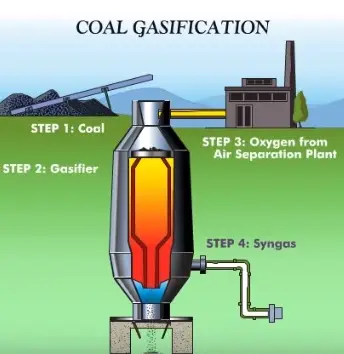
- About: Coal gasification is a thermo-chemical process that converts solid coal into a combustible gas mixture rather than burning it directly.
- Unlike traditional combustion, which releases energy through fire, gasification uses a controlled amount of oxygen and steam to break down the chemical bonds of coal.
- Process: In a pressurized vessel called a gasifier, coal is subjected to high temperatures (typically above 1,000°C) and high pressure. Instead of burning to ash, the coal reacts with steam and a limited supply of oxygen to produce Syngas (Synthetic Gas). The chemical reaction involves carbon from coal reacting with steam to produce carbon monoxide and hydrogen.
- Syngas: Syngas is the primary product of this process. It is a versatile “building block” consisting mainly of Carbon Monoxide (CO), Hydrogen (H2) and Methane (CH4) (in smaller quantities).
- Significance: It is considered “cleaner” than direct coal burning because impurities like sulfur, mercury, and ash can be filtered out of the gas before it is used, rather than trying to “scrub” them from smoke stacks.
- Since syngas is rich in hydrogen, gasification is a major pathway for producing “Blue Hydrogen” (hydrogen produced from fossil fuels with carbon capture).
- Challenges: While more versatile than burning coal, gasification still faces hurdles:
- High Capital Cost: Building gasification plants is significantly more expensive than traditional coal power plants.
- Water Intensity: The process requires large amounts of water for steam and cooling.
- Carbon Footprint: It still produces CO2. To be truly “green,” gasification must be paired with Carbon Capture, Utilization, and Storage (CCUS) technology.
ECI Announces Phase 3 of SIR
The Election Commission of India (ECI) has officially scheduled Phase 3 of the Special Intensive Revision (SIR) of electoral rolls to begin on 30th May 2026, across 16 States and three Union Territories.
- SIR: The SIR is a comprehensive exercise conducted under the supervision of the Chief Election Commissioner to update and purify electoral rolls.
- Its primary objective is to remove duplicate, deceased, shifted, and ineligible voters, including “ghost voters,” to ensure that electoral rolls accurately reflect the eligible voting population and uphold the democratic principle of “one person, one vote.”
- The SIR is anchored in Article 324 of the Indian Constitution, which grants the ECI superintendence over elections, and Section 21(3) of the Representation of the People Act (RPA), 1950, which specifically empowers the commission to order a special revision.
- Coverage: Phase 3 covers a combined voter base of 36.73 crore, extending the revision to almost the entire country except for Himachal Pradesh, Jammu and Kashmir, and Ladakh.
- After considering the completion of Phase-II of the Census in these three State/UTs and due consideration of the weather in the upper reaches/ snow bound areas, the SIR schedule for these three State/UTs will be announced later.
- Operational Mechanism: Over 3.94 lakh Booth Level Officers (BLOs) will conduct house-to-house enumeration, assisted by Booth Level Agents (BLAs) nominated by political parties.
- Identification Standards: Following Supreme Court directives, Aadhaar is recognized as the 12th document for proof of identity. However, the ECI clarified it is not proof of citizenship.
- Consistent with Phase 2, no physical documents are to be collected from electors during the house-to-house enumeration phase to streamline the process.
- Recent Trends: Data from Phase 2 revealed a voter base decline of 10.2% (approx. 5.18 crore), highlighting the impact of the revision in removing duplicate or ineligible entries.
- SIR addresses distortions caused by urbanization and rural-to-urban migration, allowing for better planning of polling logistics and the creation of new polling stations based on updated voter density.
- Transparency and Scrutiny: To prevent arbitrary deletions, the process includes draft publication, grievance redressal, and, as per Supreme Court observations in cases like the Bihar SIR, the requirement to publish details of deleted names for public transparency.


