
Current Affairs 9th May 2026 – 10 May 2026
India’s 1st Orbital Data Centre Satellite Pathfinder
Pixxel, a Bengaluru-based satellite imaging startup, has partnered with Indian AI firm Sarvam AI to develop India’s first “orbital data centre” satellite named Pathfinder. Scheduled for launch by the fourth quarter of 2026, the mission aims to place data-centre-grade Graphics Processing Units (GPUs) in low Earth orbit to process artificial intelligence workloads directly in space.
What is an Orbital Data Centre?
- About: An orbital data centre is a network or constellation of satellites equipped with powerful computing hardware (like GPUs) designed to process data directly in space.
- Traditional satellites generally collect raw data (images, signals) and transmit massive volumes of it back to Earth for analysis. Orbital data centres employ edge computing, processing the data at the source and sending the actionable insights back to ground stations.
- Significance:
- Terrestrial Constraints: Ground-based data centres are increasingly hitting limits regarding land availability, water for cooling, and energy consumption, all of which are exacerbated by the massive power demands of generative AI.
- Continuous Energy: In the right orbit, solar power is effectively continuous.
- This offers “free” electricity, which is the strongest economic argument for moving high-intensity computation to space.
- Data Bottlenecks: Earth observation satellites generate massive, high-resolution files that are expensive and slow to downlink.
- Processing this data in orbit eases the bandwidth bottleneck.
- Strategic Scaling: Future iterations of Starlink (V3) combined with the high-payload capacity of Starship could potentially deliver up to 100 GW of power to orbit, making large-scale space-based computing constellations commercially viable.
What is the Pathfinder Mission?
- About: Pathfinder is a 200-kg class satellite designed to function as a demonstrator for in-orbit data processing.
- Key Payloads & Technology:
- Datacentre-grade GPUs: Pathfinder will carry high-performance graphics processing units (GPUs) similar to those used in terrestrial data centres.
- Hyperspectral Imaging: It will carry Pixxel’s flagship hyperspectral imaging camera, capable of capturing high-fidelity data of the Earth.
- Sovereign AI Backbone: Sarvam AI will provide full-stack language models and an AI inference platform. This allows AI training and inference to occur directly on the satellite.
- Objective: To validate real-time AI inference, power management, and thermal constraints in the harsh space environment, establishing the technical groundwork for commercial-scale orbital data centres.
- Manufacturing: The satellite will be built at Gigapixxel, Pixxel’s new manufacturing facility designed to scale satellite production.
Note: Apart from this Indian space mission, the name “Pathfinder” is also famously associated with NASA’s Mars Pathfinder (1997), a historic mission that successfully landed the first robotic rover, Sojourner, on the surface of Mars.
IndiaAI–ICMR Partnership for AI in Healthcare
Recently, IndiaAI and the Indian Council of Medical Research (ICMR) signed an MoU to accelerate responsible and scalable use of Artificial Intelligence (AI) in healthcare.
- The partnership aims to create a nationally coherent and interoperable AI ecosystem for healthcare, integrating technology infrastructure with biomedical research expertise.
- AIKosh Dataset Platform: ICMR will contribute anonymised datasets, AI models, and toolkits developed under the Medical Information Data for AI Solutions (MIDAS) framework to the AIKosh platform.
- This will provide wider access to high-quality biomedical datasets for researchers, startups, and innovators across India.
- Compute Infrastructure Support: IndiaAI will provide GPU-based and high-performance computing infrastructure to ICMR at subsidised rates to support advanced AI research in healthcare and address critical infrastructure gaps.
- Global AI Governance Collaboration: In 2025, IndiaAI and ICMR’s National Institute for Research in Digital Health and Data Sciences (NIRDHDS) were recognised as Pioneer Countries under the HealthAI Global Regulatory Network (GRN), a multilateral initiative co-founded with the United Kingdom and Singapore for responsible AI governance in healthcare.
- A subsequent tripartite MoU between IndiaAI, ICMR-NIRDHDS, and HealthAI further strengthened efforts to operationalise a robust and responsible AI ecosystem for healthcare in India.
IndiaAI and ICMR
- IndiaAI is the Government of India’s flagship Artificial Intelligence initiative under the Ministry of Electronics and Information Technology (MeitY), implemented through the Digital India Corporation (DIC).
- The Indian Council of Medical Research (ICMR) is India’s apex body for biomedical and health research, responsible for coordinating and promoting medical research, disease surveillance, and public health innovation in the country.
Kerala’s Oil Spill Contingency Plan
Kerala has finalised a draft Oil Spill Contingency Plan (OSCP) to protect the state’s 590 km coastline, following recent maritime disasters off the Kerala coast involving the MSC Elsa 3 and MV Wan Hai 503.
- It has been developed under the National Oil Spill Disaster Contingency Plan (NOS-DCP) guidelines.
What are the Key Facts Regarding Kerala’s Draft Oil Spill Contingency Plan?
- Environmental Sensitivity Mapping: The plan includes Environmental Sensitive Index (ESI) mapping to identify and protect vulnerable marine ecosystems, including mangroves and fish breeding grounds.
- Shoreline Response & Management: The OSCP establishes a clear chain of command for shoreline clean-up, incorporating Net Environmental Benefit Analysis (NEBA) and specific wildlife response protocols.
- Technological Integration: It utilizes hydrodynamic and oil spill modelling to predict the trajectory of hazardous cargo, such as the calcium carbide and plastic nurdles lost during the MSC Elsa 3 sinking.
- Jurisdiction & Scope: The plan covers marine spills within 12 nautical miles (Territorial Waters) and extends 40 km into inland riverine systems affected by tidal action.
What is the National Oil Spill Disaster Contingency Plan?
- About: NOS-DCP is India’s apex policy framework for responding to oil and chemical spills in Indian waters. Originally formulated in 1993 and promulgated in 1996, the plan was significantly updated in 2024 to address growing maritime traffic, larger tankers, offshore exploration, and emerging risks from offshore wind energy.
- Core Objectives: Establish seamless coordination among various ministries, ports, oil companies, and coastal states.
- Identify and protect ecologically sensitive zones (like mangroves and coral reefs) that require immediate protection during a spill.
- Ensure that the “Polluter Pays” principle is enforced through legal and financial mechanisms.
- Key Features of NOS-DCP (2024 Updates):
- Integrated Digital Tracking: Use of real-time satellite imagery, Automatic Identification System (AIS), and the Online Oil Spill Advisory (OOSA) system for tracking and trajectory modelling of oil spills.
- Tiered Response Refinement: The 2024 guidelines clarified the specific “Trigger Points” for different spill sizes:
- Tier 1 (Small): Handled by the individual port or oil facility (Up to 700 tonnes).
- Tier 2 (Medium): Requires regional resources/District administration (700 to 10,000 tonnes).
- Tier 3 (Large): Becomes a National Disaster, handled by the ICG and National Authorities (Over 10,000 tonnes).
- Enhanced Chemical Preparedness: With the increase in chemical transport, there is a heightened focus on Hazardous and Noxious Substances (HNS).
- Dispersant Policy: New chemical dispersants were approved in 2024, focusing on “low-toxicity” variants to minimize the impact on marine life compared to older chemical standards.
- Inclusion of Offshore Wind Farms: It includes specific response protocols for the burgeoning offshore wind energy sector in India’s Exclusive Economic Zone (EEZ).
- Institutional Framework:
| Entity | Role under NOS-DCP |
| Indian Coast Guard (ICG) | Indian Coast Guard (ICG) serves as the Central Coordinating Authority and maintains the National Inventory of pollution response equipment. |
| Directorate General of Shipping | Handles legal issues, ship-related regulations, and salvage operations. |
| INCOIS (Hyderabad) | Provides “Oil Spill Trajectory” models to predict where the oil will drift based on wind and currents. |
| Ministry of Environment (MoEFCC) | Identifies and prioritizes “Environmentally Sensitive Areas” (ESAs) for protection. |
- Major Exercise: The ICG conducted the 10th National Level Pollution Response Exercise (NATPOLREX-X) off the coast of Chennai in October 2025 to test the efficiency of inter-agency coordination between the ICG, coastal states, and international observers (from 32 countries).
Oil Spill
- About: An oil spill is the accidental or intentional release of liquid petroleum hydrocarbons (crude oil or refined products) into the environment, particularly marine ecosystems.
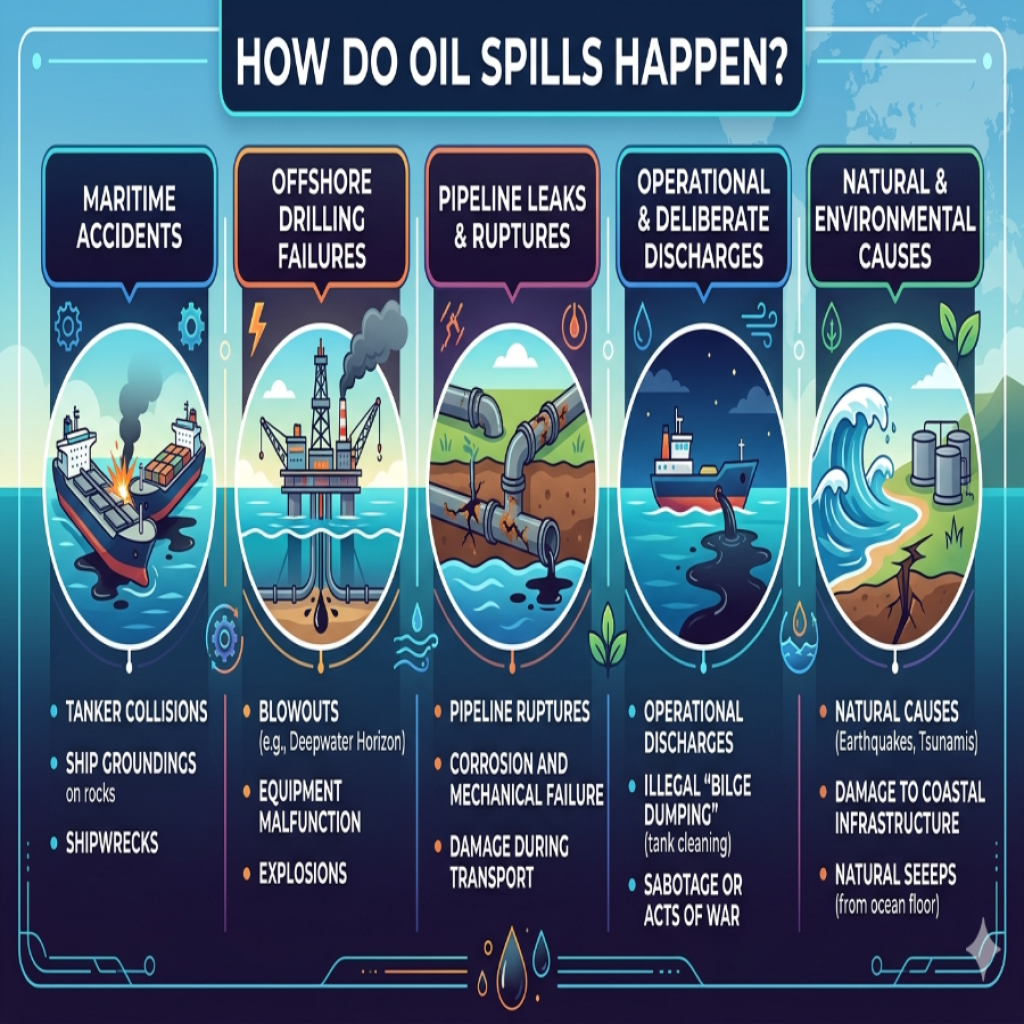
- Environmental Impact: When oil spills into water, it forms a thin layer called an oil slick that spreads rapidly across the surface. The consequences are severe:
- Wildlife Damage: Oil coats the feathers of birds and the fur of mammals (like sea otters), destroying their ability to insulate and stay buoyant, often leading to hypothermia or drowning.
- Ecosystem Disruption: Thick oil can coat the roots of mangroves or settle on coral reefs, cutting off oxygen and light, leading to the death of entire coastal “nurseries.”
- Human Impact: Spills contaminate local fisheries, destroy tourism, and can even affect human health through the inhalation of toxic vapors or the consumption of contaminated seafood.


