Current Affairs 6th – 7th May 2026
Important topics for clat 2027 GK section
Iran’s Nuclear Threshold and NPT Compliance
The geopolitical tension surrounding Iran’s nuclear program highlights a strategic balance under the Non-Proliferation of Nuclear Weapons (NPT), where Iran maintains the technical capability for weaponization while officially adhering to a civilian-use narrative.
What are the Key Facts Regarding Iran’s Nuclear Ambiguity?
- NPT Paradox: The NPT recognises an inalienable right to civilian nuclear technology, but because enrichment and reprocessing can serve both peaceful and weapons purposes, it creates a blurred line between energy use and weaponisation that Iran’s nuclear programme exemplifies.
- Technical Proximity: Iran possesses a significant stockpile of uranium enriched to 60%; experts note that the path from 60% to the 90% weapons-grade threshold is technically shorter than the initial enrichment stages.
- Iran is classified as a threshold state—a nation possessing the breakout capability (technical knowledge and material) to build a bomb rapidly but refraining from the final assembly to avoid international sanctions.
- Analysts estimate Iran’s current breakout time—the period required to produce enough fissile material for a warhead—is now measured in weeks, effectively making it a nuclear-capable state. North Korea was once an example; Iran now is one.
- Nuclear Cascade Risk: Iran’s status as a threshold state risks a regional nuclear cascade, where neighboring countries may feel compelled to seek nuclear parity to ensure their own security.
- JCPOA Factor: The Joint Comprehensive Plan of Action (JCPOA) 2015, or the 2015 Iran Deal, successfully curtailed enrichment until the US unilaterally exited in 2018, leading Tehran to resume high-level enrichment.
- Covert Actions Against Iran: Includes Stuxnet virus in late 2000s (highly sophisticated computer worm discovered designed to sabotage Iran’s nuclear program by physically damaging centrifuges), assassination of nuclear scientists, Twelve-Day War (2025) , and ongoing conflict – aimed at eliminating even threshold state status.
What is Non-Proliferation of Nuclear Weapons (NPT)?
- About:NPT is a landmark international agreement aimed at preventing the spread of nuclear weapons and technology, promoting cooperation in the peaceful uses of nuclear energy, and furthering the goal of achieving nuclear disarmament.
- Opened for signature in 1968 and entered into force in 1970, it is the most widely adhered-to arms control treaty in history.
- Three Pillars: The NPT is often described as a “grand bargain” based on three central pillars:
- Non-Proliferation: Non-Nuclear Weapon States (NNWS) agree not to acquire or manufacture nuclear weapons. Nuclear Weapon States (NWS) agree not to assist NNWS in acquiring them.
- Disarmament: All parties—specifically the NWS—commit to pursuing negotiations in good faith to halt the nuclear arms race and achieve complete disarmament.
- Peaceful Use of Nuclear Energy: All parties have the “inalienable right” to develop nuclear energy for peaceful purposes (such as power generation or medicine) under international supervision.
- Nuclear “Have” vs. “Have-Nots”: The treaty creates a legal distinction between two groups of states:
- Nuclear Weapon States (NWS): Defined as those that manufactured and exploded a nuclear weapon or other nuclear explosive device prior to 1st January, 1967. This includes only five countries: the United States, Russia, the United Kingdom, France, and China (the P5).
- Non-Nuclear Weapon States (NNWS): All other signatories, who agree to forgo the nuclear path.
- Verification and the IAEA: To ensure that NNWS are not diverting nuclear material from peaceful power plants to secret weapons programs, the treaty relies on the International Atomic Energy Agency (IAEA). Signatories must accept IAEA “safeguards,” which involve regular inspections of their nuclear facilities.
- Criticisms:
- Discriminatory Nature: Many argue the treaty is inherently unfair because it “freezes” the world into nuclear “haves” and “have-nots,” with no strict deadline for the P5 to disarm.
- Non-Signatories: Four UN member states have never joined the NPT namely India, Pakistan, Israel, and South Sudan. North Korea acceded in 1985, announced its withdrawal in 2003 (the only state to do so), and subsequently developed nuclear weapons. Iran joined NPT in 1970 but recently expressed doubts about continued participation.
- Withdrawal Clause: Article X allows a state to withdraw if “extraordinary events” jeopardize its supreme interests, which some see as a loophole for “breakout” capabilities.
RBI’s Strategic Gold Repatriation
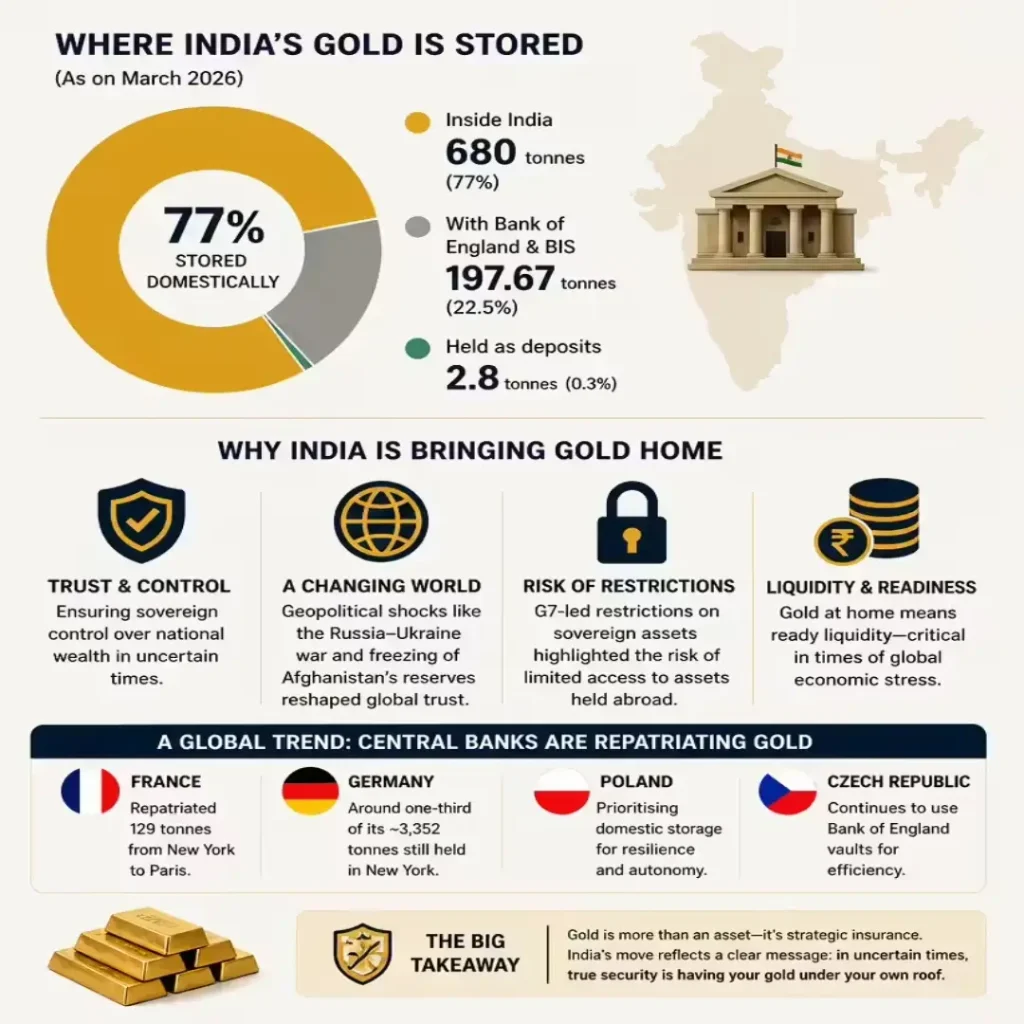
The Reserve Bank of India (RBI) moved 104.23 metric tonne (MT) of gold from the Bank of England and the Bank for International Settlements (BIS) to domestic shores in the 2nd half of 2025-26.
- 3 Year Trend: This marks the 3rd consecutive year of large-scale gold transfers, with 168.06 MT brought home in 2025-26, compared to 107.21 MT and 103.68 MT in the preceding two years.
- Approximately 197.67 tonnes remain with the Bank of England and the Bank for International Settlements, as India reduces its historical reliance on London and New York vaults.
- Dominant Domestic Holdings: As of March 2026, the RBI holds 77% of its total 880.52 MT gold reserves domestically, a dramatic increase from just 38% in March 2023.
- Geopolitical Resilience: The move is a response to global uncertainties following the 2022 Russia-Ukraine conflict and the freezing of Russia’s dollar reserves, prompting central banks to favor “domestic storage” to avoid potential sanctions or asset freezes.
- Increased Share in Forex: The value-wise share of gold in India’s Foreign Exchange Reserves jumped to 16.7% (up from 11.7% in 2024-25), driven by a sharp rally in global gold prices.
- The foreign exchange reserves are composed of 4 distinct categories namely Foreign Currency Assets (~80.0%), Gold Reserves (~16.7%), Special Drawing Rights (~2.4%) and Reserve Position in IMF (~0.9%).
- Reserve Bank of India (RBI) Act, 1934 outlines the types of foreign assets the RBI is permitted to buy and hold (e.g., foreign government securities, deposits with foreign central banks).
- Global Context: According to the World Gold Council, despite an increase in domestic gold storage, RBI’s overall gold reserves grew by only 10% (86 MT) over the last 3 years.
- This trend contrasts with central banks like the National Bank of Poland, Uzbekistan, and China, which purchased gold heavily in early 2026 to diversify reserves amid geopolitical conflicts.
CINBAX-II 2026
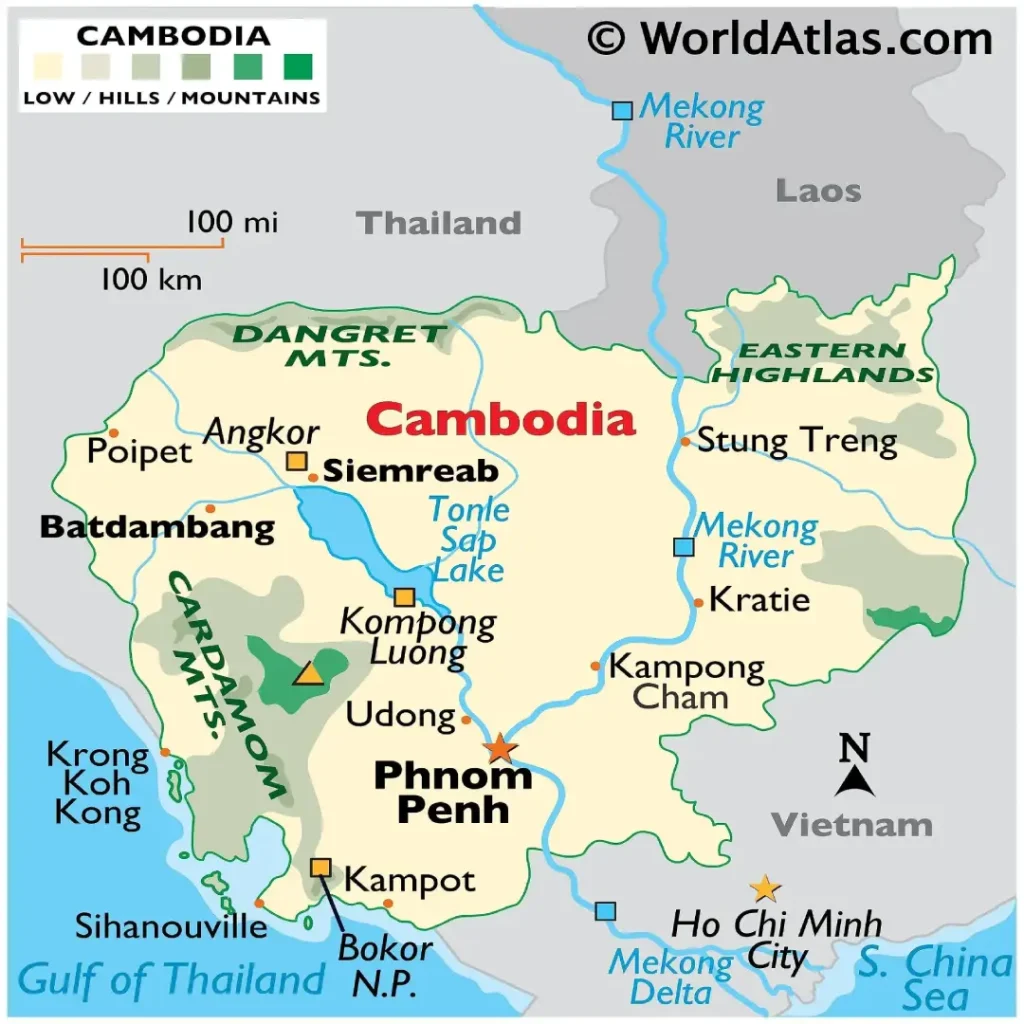
The Indian Army is participating in the 2nd edition of the India-Cambodia Joint Military Exercise, CINBAX-II 2026, held in Kampong Speu Province, Cambodia. The inaugural edition of CINBAX was held in Pune, India, in December 2024.
- Contingent Details: 120 personnel from India, primarily from a Battalion of the Maratha Light Infantry Regiment, joined 160 personnel from the Royal Cambodian Army for the exercise.
- Objective: To achieve operational synergy, share best practices, and enhance coordination during joint missions focused on countering hostile forces.
- Focus Area: The exercise focuses on Counter-Terrorism (CT) operations within sub-conventional environments, specifically in semi-urban and jungle settings.
- The 2026 edition includes training in modern combat skills such as drone operations, sniper tactics, and mortar handling.
- Mandate: It is conducted under the framework of Chapter VII of the UN Charter, aligning with the dynamics of modern UN peacekeeping operations.
- Chapter VII of the UN Charter authorizes the UN Security Council to take decisive action, including binding economic sanctions and military force, to maintain or restore international peace and security.
- Strategic Significance: CINBAX is aimed at strengthening defence cooperation between India and Cambodia under India’s broader military diplomacy and Act East Policy, 2014.
INS Mahendragiri Inducted into Indian Navy
The Indian Navy recently took delivery of INS Mahendragiri, the sixth ship in the Nilgiri-class (Project 17A), marking a significant milestone in India’s push for self-reliance in warship design and construction.
- It is the latest addition to a series of multi-role stealth frigates, including INS Dunagiri and INS Taragiri, that represent a significant leap in the Navy’s modernization.
INS Mahendragiri
- Design and Features: Designed by the Warship Design Bureau, the frigate is equipped with a CODOG (Combined Diesel or Gas) propulsion system, advanced sensors, and a versatile weapons suite for anti-surface, anti-air, and anti-submarine operations.
- The frigate has 75% indigenous content, showcasing India’s growing capability in indigenous warship manufacturing.
- Stealth: The ship is designed with a low radar cross-section (RCS), reducing its visibility to enemy sensors and radars.
- Key features include radar-absorbing coatings, flush-mounted weapons, and specialized exhaust systems for infrared signature reduction.
- Firepower: Equipped with BrahMos missiles, MFSTAR radar, and MRSAM air defense systems, INS Mahendragiri enhances India’s combat capability in both offensive and defensive operations.
- Significance: The growing fleet of indigenous warships reflects India’s broader effort to enhance its blue-water operational capabilities and maintain a sustained presence in the Indian Ocean Region.
Project 17A
- About: Project 17A, also known as the Nilgiri-class, comprises the development and deployment of seven stealth guided-missile frigates developed as a follow-on to the Shivalik-class (Project 17).
- Of the seven frigates, four (Nilgiri, Udaygiri, Taragiri, Mahendragiri) are being built by Mazagon Dock Shipbuilders Ltd (MDL), and three (Himgiri, Dunagiri, Vindhyagiri) by Garden Reach Shipbuilders & Engineers Ltd.
- Significance: Project 17A frigates are designed for blue-water operations, enabling the Navy to project power across vast distances and protect maritime trade routes.

1 Year of Operation Sindoor
Marking the one-year anniversary of Operation Sindoor, the Indian armed forces have significantly transitioned toward a high-tech, resilient defense posture characterized by hardened underground infrastructure and an integrated, multi-layered air defense shield.
What Steps have been Taken Post Operation Sindoor to Strengthen India’s Defence Capabilities?
- Subterranean Warfare Infrastructure: A primary focus has shifted to constructing large-scale underground command and control centers at the Command and Corps levels to ensure operational continuity during active conflict.
- These facilities are being equipped with C4I2SR (Command, Control, Communications, Computers, Intelligence, Information, Surveillance, and Reconnaissance) systems to provide real-time situational awareness across all military branches.
- Technological Innovations in Construction: The military is utilizing 3D-printed bunkers for rapid deployment and resilience, alongside hardened bunkers for fuel, ammunition, and medical facilities along the Western borders.
- Evolution of Air Defense: Following lessons from drone swarms during Operation Sindoor, India is establishing a comprehensive shield under Mission Sudarshan Chakra and enhancing the Akashteer (Army), Integrated Air Command and Control System (IACCS) (Air Force), and TRIGUN (Navy) integrated networks.
- Counter-UAS and Drone Strategy: Procurement has prioritized counter-UAS (Unmanned Aircraft Systems) to neutralize low-cost drone threats, integrating new sensors with legacy systems like L/70 anti-aircraft guns.
- Strategic Dual-Use Infrastructure: Expansion includes emergency landing fields (ELFs) on national highways (e.g., Purvanchal Expressway) and the conversion of border airfields for civil-military dual use.
- Offensive Air Defense: Capabilities have expanded to “deny the enemy their own airspace” using long-range systems like the S-400 Triumf and the indigenous Project Kusha (Long-range Surface-to-Air Missile system).
- During Operation Sindoor, the IAF recorded the largest-ever surface-to-air kill, neutralizing a Pakistani airborne platform from a distance of approximately 300 km.
What is Operation Sindoor?
About: Operation Sindoor was a multi-dimensional military and strategic offensive launched by India on the night of 7–8th May, 2025. It was conducted in response to a major terror attack in Pahalgam, Jammu & Kashmir, on 22nd April, 2025, where 26 tourists were killed by the Pakistan-backed group The Resistance Front (TRF).
Military Execution (The Kinetic Response)
- Targeted Strikes: The Indian Air Force (IAF) used Rafale jets equipped with SCALP missiles and HAMMER bombs to destroy 9 major terror launchpads across Pakistan and Pakistan-occupied Jammu & Kashmir (PoJK).
- Elimination of Terrorists: Over 100 terrorists were reportedly killed, including high-ranking handlers from groups like Lashkar-e-Taiba (LeT) and Jaish-e-Mohammed (JeM).
- Counter-Escalation: When Pakistan responded with drone strikes and artillery, India targeted Pakistani military infrastructure, including radar installations in Lahore and airbases such as Sargodha and Nur Khan.
- The Ceasefire: Following intense skirmishes, a ceasefire was reached on 10th May, 2025, after Pakistan’s DGMO reached out to the Indian side.
Non-Military Measures
- Indus Waters Treaty (IWT): In a historic move, India held the 1960 Indus Waters Treaty in abeyance using India’s upstream control as a strategic lever.
- Economic Isolation: India suspended all bilateral trade and closed the Attari-Wagah border. Imports of textiles and cement from Pakistan were banned, and key exports like onions were halted to exert maximum fiscal pressure.
- Diplomatic Offensive: India dispatched “All-Party Delegations” globally to present forensic evidence of the Pahalgam attack, effectively isolating Pakistan on the world stage.
Key Outcomes
- “Nuclear Bluff” Called: By striking deep into Pakistani territory (including mainland Punjab) without triggering a nuclear escalation, India demonstrated its ability to operate within the “grey zone.”
- Tri-Service Integration: The operation fast-tracked the creation of the Joint Operations Control Centre (JOCC) and boosted the transition toward Theatre Commands.
- Atmanirbharta (Self-Reliance): The mission relied heavily on Made-in-India weapons and indigenous technology, including the Akash missile system and anti-drone platforms.
National Counter-Terrorism Policy and Strategy: PRAHAAR
The Ministry of Home Affairs (MHA) has launched ‘PRAHAAR’, a landmark National Counter-Terrorism Policy and Strategy that transitions India from a reactive security posture to a proactive, whole-of-government doctrine.
- P — Prevention of Terror Attacks: Focus is shifting to a proactive, intelligence-led approach through real-time intelligence sharing through the Multi Agency Centre (MAC) and Joint Task Force on Intelligence (JTFI).
- R — Responses: Swift and proportionate response to neutralize threats. Local police act as first responders, supported by State Counter-Terror Forces and the National Security Guard (NSG).
- A — Aggregating Internal Capacities: Standardization of training by the Bureau of Police Research & Development (BPR&D) and modernization of weaponry.
- H — Human rights and ‘Rule of Law’ based Processes: Balancing national security with the Protection of Human Rights Act (1993) and providing a multi-level judicial redressal system.
- A — Attenuating the Conditions Enabling Terrorism: Multi-stakeholder de-radicalization frameworks involving community leaders and NGOs.
- A — Aligning and Shaping the International Efforts: Utilizing Mutual Legal Assistance Treaties (MLATs) and Extradition Treaties to facilitate evidence sharing and the deportation of fugitives. Diplomatic efforts at the United Nations to designate global terrorists and deny safe havens.
- R — Recovery and Resilience: Minimizing impact through a “whole-of-society” approach. Building long-term psychological and physical strength within communities to ensure life returns to normal swiftly post-incident.
SC Expands Definition of Acid Attack Victims Under RPwD Act, 2016
The Supreme Court of India has broadened the scope of the Rights of Persons with Disabilities (RPwD) Act, 2016, ruling that survivors of forcible acid ingestion must be legally recognised as ‘acid attack victims’.
Supreme Court Rule Regarding the Acid Attack Victims
- Expansion of the Term ‘Acid Attack Victim’: The Court has formally included survivors who were forcibly administered or forced to ingest acid.
- Previously, the RPwD Act, 2016, only covered individuals disfigured by the throwing of acid.
- The ruling clarified that victims suffering from severe internal organ damage due to acid exposure are fully entitled to protection and disability benefits, even if they do not exhibit any visible external disfigurement.
- Retrospective Applicability: To ensure complete justice, the Court directed that this expanded definition will operate retrospectively from 2016 (when the RPwD Act, 2016, was enacted).
- This critical move allows past victims of forced acid ingestion to retroactively claim disability benefits, financial aid, and official disability identity cards that they were previously denied.
- Interim “Deemed Amendment” via Article 142: Recognising the urgency of the situation, the Supreme Court did not wait for Parliament to officially amend the law.
- Instead, it invoked its extraordinary plenary powers under Article 142 of the Constitution to pass this as a “deemed amendment,” effectively acting as the law until the Union Government formally amends the Schedule of the RPwD Act, 2016.
- Observations on Accountability and Deterrence:
- Compensation via Attackers: The Court suggested attaching the assets of attackers (including their share in Joint Hindu Family properties) to adequately compensate victims..
- Reversing the Burden of Proof: To combat the issue, the court suggested reversing the burden of proof onto the accused and recommended that sellers involved in illegal or unregulated transactions of corrosive substances and acid be made co-accused in such cases.
Rights of Persons with Disabilities (RPwD) Act, 2016
- Origin and Background: The Act was enacted to fulfil India’s obligations under the United Nations Convention on the Rights of Persons with Disabilities (UNCRPD), which India ratified in 2007.
- It replaced the outdated Persons with Disabilities Act of 1995 and shifted the legal framework from a welfare-based charity model to a rights-based approach.
- Expanded Categories: It increased the number of recognized disabilities from 7 to 21. Acid attack victims fall under the category of physical/locomotor disability.
- It included conditions such as Autism Spectrum Disorder, Cerebral Palsy, Dwarfism, Hemophilia, Multiple Sclerosis, Parkinson’s disease, Sickle Cell disease, and Specific Learning Disabilities.
- It empowers the Central Government to add more types of disabilities to the list as needed.
- Key Rights and Entitlements:
- Right to Free Education: Every child with a benchmark disability between the ages of 6 and 18 years has the right to free education (an extension of the RTE Act, 2009 which covers ages 6 to 14).
- Reservation in Employment: The reservation for PwDs in government establishments was increased from 3% to 4% for certain persons or classes of persons with benchmark disabilities.
- Reservation in Education: It mandates a 5% reservation of seats in government and government-aided higher educational institutions for persons with benchmark disabilities.
- Accessibility: It mandates that all public buildings, transport systems, and information/communication technologies be made barrier-free and fully accessible to PwDs within a stipulated timeframe.
- Guardianship and Legal Capacity: The Act transitions from plenary guardianship (where the guardian takes all decisions) to “limited guardianship,” where decisions are made jointly with the person with a disability, ensuring their agency is respected.
- Institutional Mechanism: Mandates the establishment of Central and State Advisory Boards and the appointment of Chief Commissioners for PwDs to monitor the law’s implementation.
Laws Regarding Acid Attacks in India?
- About: Acid attacks are categorized as premeditated assaults where corrosive substances—primarily sulphuric, hydrochloric, or nitric acid—are thrown at a person to cause maximum physical and psychological damage.
- The cost of lifelong surgeries and the resulting disabilities often lead to financial ruin and exclusion from the workforce.
- Law Commission of India’s 226th Report (2009) recognised acid attacks as crimes causing permanent physical and psychological harm, stressed their gendered nature, and called for distinct penal provisions and rehabilitation support.
- Prevalence of Acid Attack in India: The National Crime Records Bureau (NCRB) reported 207 cases in 2023, up from 176 in 2021.
- While official figures are in the hundreds, Acid Survivors Trust International (ASTI) estimates there are approximately 1,000 attacks annually in India, suppressed by social stigma and fear of retaliation.
- West Bengal, Uttar Pradesh, and Gujarat were the worst-affected states in 2023.
- High prevalence is often linked to the proximity of industries like textiles and rubber, where acid is easily accessible despite regulations.
- While official figures are in the hundreds, Acid Survivors Trust International (ASTI) estimates there are approximately 1,000 attacks annually in India, suppressed by social stigma and fear of retaliation.
Legal Provisions for Acid Attack Survivors
- Bharatiya Nyaya Sanhita (BNS), 2023: Under Section 124, voluntarily causing grievous hurt by the use of acid (either by throwing or administering) is a cognizable and non-bailable offence.
- It is punishable with a minimum of 10 years imprisonment, which can extend to life, along with a fine.
- Bharatiya Nagrik Suraksha Sanhita (BNSS), 2023:
- Section 397: Mandates all hospitals (public or private) to provide free, immediate first-aid and medical treatment to victims and immediately inform the police.
- Section 396: Establishes the statutory Victim Compensation Scheme to provide funds for the rehabilitation of victims or their dependents who have suffered loss or injury due to a crime..
- NALSA (Legal Services to Victims of Acid Attacks), Scheme, 2016: Under the Legal Services Authorities Act, 1987, the National Legal Services Authority (NALSA), through the NALSA (Legal Services to Victims of Acid Attacks) Scheme, 2016, provides priority legal aid, support, and assistance to acid attack victims and their heirs.
- Financial assistance: The Compensation Scheme for Women Victims/Survivors of Sexual Assault and Other Crimes (2018), developed by the NALSA, provides uniform financial compensation to women survivors of crimes such as sexual assault, acid attacks, and severe domestic violence.
- In addition, acid attack victims are provided an extra financial assistance of Rs 1 lakh under the Prime Minister’s National Relief Fund, over and above the compensation available under the Victim Compensation Scheme.
- Landmark Judgments:
- Laxmi vs Union of India (2014): The Supreme Court issued strict guidelines for regulating acid sales, banning over-the-counter sales to minors, requiring buyer ID cards, and mandating sellers to report stocks.
- Parivartan Kendra vs Union of India (2015): The Supreme Court flagged poor implementation of acid sale regulations and directed States to ensure effective enforcement and timely compensation for survivors.
- Justice JS Verma Committee (2013): In the aftermath of the Nirbhaya case, the Justice JS Verma Committee examined structural failures in addressing violence against women and explicitly highlighted acid attacks as a gendered crime.
- The Committee recommended stringent punishment, and a national survivor fund for compensation, directly influencing later reforms on acid violence.
Cabinet Clears Bill to Expand SC Strength to 38
The Union Cabinet has approved the Supreme Court (Number of Judges) Amendment Bill, 2026, to increase the sanctioned strength of the Supreme Court from 34 to 38 (including the Chief Justice of India).
- This change will be enacted by amending the Supreme Court (Number of Judges) Act, 1956, ending a six-year hiatus since the last revision in 2019.
- The expansion is in response to a backlog of 92,385 cases, further complicated by the post-pandemic surge in digital e-filings.
What is the Process to Increase the Sanctioned Strength of the Supreme Court?
- Constitutional Foundation: Under Article 124(1) of the Indian Constitution, the Supreme Court originally consisted of a Chief Justice and 7 other judges. However, the Constitution explicitly gives Parliament the power to increase this number by law.
- Unlike the High Courts, where the President can increase the number of judges (under Article 216) through executive orders based on workload, the Supreme Court’s sanctioned strength can only be changed through an Act of Parliament.
- Legislative Process: To increase the strength, the following steps are typically followed:
- Initiation by CJI: Usually, the Chief Justice of India (CJI) sends a proposal to the Union Ministry of Law and Justice, citing reasons like a rising backlog of cases or the need for more Constitution Benches.
- Cabinet Approval: The Law Ministry, after consulting with the Finance Ministry (for budgetary implications), places a draft bill before the Union Cabinet.
- Introduction of Amendment Bill: Once the Cabinet approves, the government introduces the Supreme Court (Number of Judges) Amendment Bill in Parliament.
- Parliamentary Approval: The bill must be passed by both the Lok Sabha and the Rajya Sabha by a simple majority.
- Presidential Assent: Once passed by both Houses, the bill is sent for the President’s assent; upon receiving it, the bill becomes an Act, and the sanctioned strength is officially increased.
- Implementation: The President (on the advice of the Collegium) can then appoint additional judges up to the new sanctioned strength.
- Evolutionary Trend: From an original constitutional strength of 1+7 judges, the court has expanded progressively (e.g., to 10 in 1956, 13 in 1960, 17 in 1977, and 25 in 1986) to match India’s growing legal needs.
RBI’s UDGAM Portal
The Supreme Court is reviewing the operation of the UDGAM portal in response to a Public Interest Litigation (PIL) highlighting concerns about dormant funds being transferred to government-managed pools and the challenges heirs face in accessing them.
- About: The UDGAM (Unclaimed Deposits – Gateway to Access Information) portal, launched by the Reserve Bank of India (RBI), allows users to identify unclaimed deposits/accounts across multiple banks, enabling them to claim the deposits or reactivate their accounts.
- While the portal facilitates identifying unclaimed deposits, it does not handle claim settlements; claimants must contact the respective banks directly for claim processing.
- Integration: The portal integrates 30 banks that account for nearly 90% of the funds in the Depositors’ Education and Awareness Fund (DEAF), with over 20 lakh users and 44 lakh searches conducted by 1st April 2026.
- Features: Since its August 2023 launch, several enhancements have been introduced, including optional user registration, an improved search interface with address-based queries, and relaxed restrictions on logins and searches.
- Challenges:
- Lack of Integration for Various Assets: It does not include post office deposits, provident funds, and insurance schemes, making it difficult for legal heirs to access all unclaimed assets.
- Unawareness of Unclaimed Funds: Unclaimed funds often remain inaccessible because legal heirs are unaware of them, or banks fail to inform heirs about dormant accounts.
- Complicated Claims Process: The process of claiming unclaimed funds is complicated, especially when there is a clear and undisputed will, as banks require legal documents like succession certificates or probate.