
Current Affairs 13th May 2026 Daily Current Affairs 2026
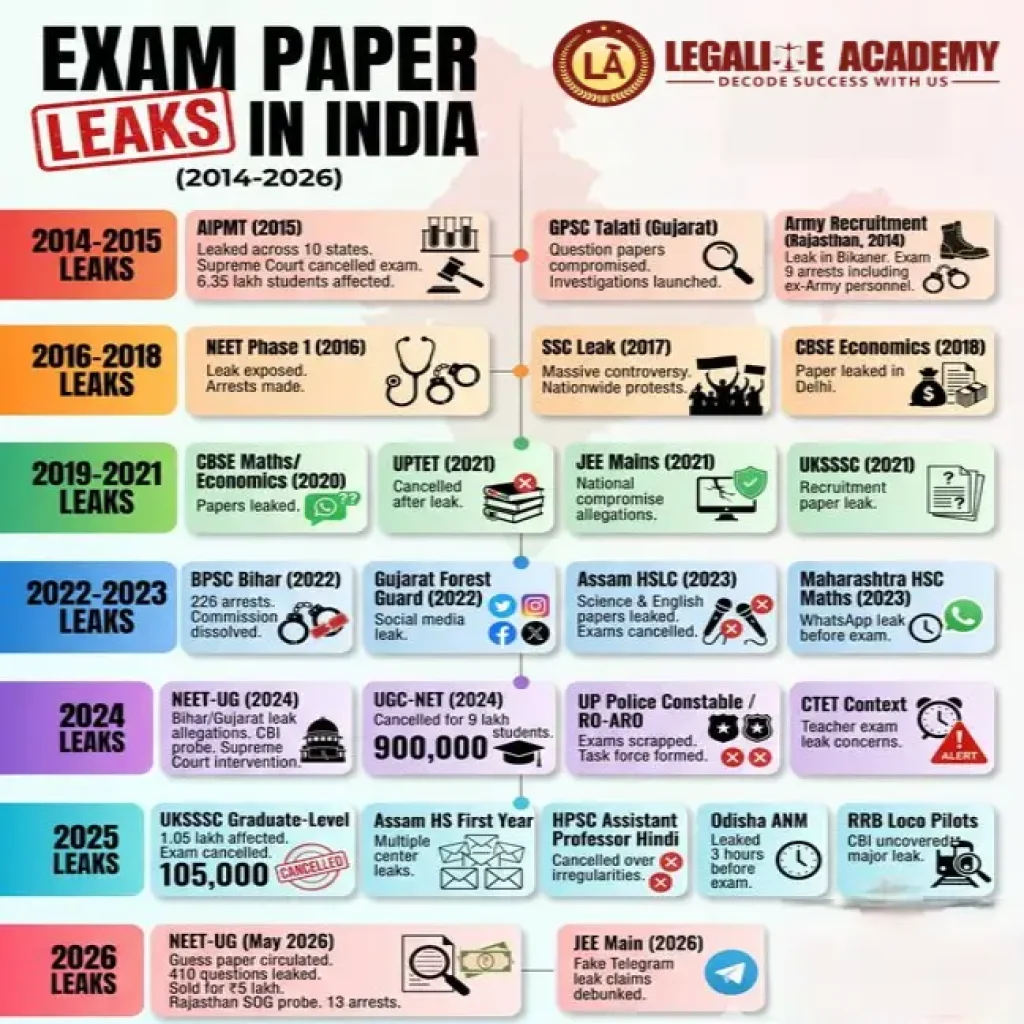
NEET-UG 2026 Paper Leak: Crisis in India’s Examination System
The National Testing Agency (NTA) cancelled the National Eligibility Entrance Test (NEET-UG) 2026 examination following allegations of a major paper leak and the circulation of a highly accurate “guess paper,” with the probe now handed over to the Central Bureau of Investigation.
- The controversy has reignited concerns over transparency and systemic failures in India’s exam ecosystem, alongside delays in the full-scale implementation of the Dr. K. Radhakrishnan Committee (2024) (High-Level Committee of Experts) recommendations
National Testing Agency (NTA)
- About: The National Testing Agency (NTA) is a specialized, autonomous, and self-sustained organization established by the Ministry of Education to conduct transparent, efficient, and internationally standardized entrance examinations for higher education in India.
- Established in 2017, the NTA is a Society registered under the Indian Societies Registration Act, 1860. It is not a statutory body created by an Act of Parliament, but instead relies on the executive powers of the Union Government.
- Key Examinations Conducted: The agency is responsible for administering massive high-stakes undergraduate admissions, including JEE-Main (Engineering), NEET-UG (Medicine), and CUET-UG.
- It also conducts crucial postgraduate and eligibility assessments such as CUET-PG, UGC-NET (for Assistant Professor and JRF), and CSIR UGC-NET.
- Governance & Leadership: The NTA is overseen by a Governing Body comprising eminent educationists and members from user institutions.
- Its operations are led by the Director General (DG) as its Chief Executive Officer, a post generally at the rank of Joint Secretary to the Government of India.
- Core Strategic Functions: The agency’s operational goals include identifying secure partner institutions for online testing, creating scientifically vetted question banks, and building a robust Research & Development (R&D) culture in educational testing.
Key Recommendations of the Dr. K. Radhakrishnan Committee(2024)?
- About: The High-Level Committee of Experts constituted by the Union Ministry of Education in 2024 to suggest reforms for the National Testing Agency (NTA) is led by Dr. K. Radhakrishnan, former Chairman of ISRO.
- It was established following widespread concerns and reports of paper leaks/irregularities in the NEET-UG 2024 and UGC-NET examinations.
Recommendations
- Comprehensive Restructuring of NTA: The Committee recommended transforming the National Testing Agency into a more autonomous, professional, and accountable body with dedicated verticals for technology, security, operations, ethics, and transparency.
- Introduction of DIGI-EXAM System: The Committee proposed a “DIGI-EXAM” model similar to DigiYatra, using Aadhaar-linked authentication, biometrics, and AI-driven identity verification to ensure only genuine candidates appear for examinations.
- Hybrid and Technology-Driven Examination Models: To reduce vulnerabilities in traditional pen-and-paper exams, the Committee recommended Computer-assisted Secure Pen-and-Paper Testing (CPPT), where encrypted papers are digitally transmitted and printed directly at examination centres under strict security protocols.
- However, the National Testing Agency continued relying on GPS-enabled vehicles and police escorts instead of implementing the system.
- Multi-Session and Multi-Stage Testing: For large-scale exams like NEET-UG, it proposed conducting exams across multiple sessions and explore multi-stage screening models to reduce logistical pressure and improve fairness.
- Testing Centers & Allocation: Candidates should ideally get testing centers in their home districts. NTA should use data analytics to detect suspicious patterns in center choices to prevent organized malpractices. An NTA “Presiding Officer” should oversee each center.
- Creation of Secure Standardised Testing Centres: It recommended establishing at least 1000 permanent secure testing centres across the country, mainly in reputed government institutions, equipped for CBT, pen-and-paper testing (PPT), and hybrid testing modes.
- Mobile Testing Centres for Remote Areas: To improve inclusivity, the Committee proposed mobile testing centres for remote and inaccessible regions such as the North-East, Himalayan states, and island territories, ensuring equitable access to national examinations.
- AI-Based Grievance Redressal Mechanism: The report stressed building a technology-enabled grievance redressal system with multilingual AI chatbots, rapid complaint resolution, and expert committees for sensitive cases to improve transparency and student trust.
- Continuous Training and Capacity Building: The Committee highlighted the need for regular training and retraining of invigilators, administrators, technical staff, and security personnel to adapt to evolving examination technologies and cyber threats.
- Coaching Oversight: State or Central governments should establish oversight mechanisms for the increasingly dominant private coaching industry, while simultaneously empowering the standard High School education system.
- Long-Term Structural Reforms: In the long run, the report recommended harmonisation of entrance tests, transition towards Computer Adaptive Testing, stronger cybersecurity systems, research in psychometrics, and building India into a global leader in educational testing standards.
Key Provisions of Public Examinations (Prevention of Unfair. Means) Act, 2024
- Institutional Scope: The Act specifically governs examinations conducted by central authorities, including the UPSC, SSC, Railway Recruitment Boards (RRBs), IBPS, and the National Testing Agency (NTA).
- Stringent Penalties: It introduces deterrent sentencing, with prison terms ranging from 3 to 5 years for individual offenders and up to 10 years for those involved in organized crime syndicates, accompanied by substantial fines.
- Codification of Malpractices: The legislation defines 20 specific offences, effectively covering modern threats such as impersonation, tampering with OMR sheets, and unauthorized access to computer networks.
- Technological Fortification: A National Technical Committee is mandated to develop fail-safe protocols for IT security and enhance the integrity of computer-based tests (CBTs).
- Federal Influence: While the Act excludes state-level and university examinations, it is intended to function as a model law for State Governments to harmonize anti-cheating regulations across the country.
- Administrative Efficiency: By reducing examination cycles and supplementing initiatives like self-attestation, the Act seeks to create a more efficient and credible recruitment ecosystem.
IMD’s New AI-Driven Weather Forecasting Systems
India Meteorological Department (IMD) unveiled two cutting-edge AI-based weather forecasting tools to provide high-precision, localized data, marking a significant milestone in India’s disaster preparedness and agricultural strategy, while supporting the goals of Mission Mausam.
- These developments build upon the Bharat Forecasting System (BharatFS), aimed at strengthening India’s next-generation weather forecasting capabilities.
IMD’s New AI-Driven Weather Forecasting Systems
- AI-enabled Forecast of Monsoon Advance: It is India’s first Artificial Intelligence-based monsoon forecasting system designed to forecast the advance of the southwest monsoon at the ‘block level’, marking a major shift towards hyper-local weather forecasting.
- The system issues probabilistic forecasts every Wednesday for the next four weeks, helping farmers precisely plan sowing, irrigation, crop protection and harvesting activities.
- The system blends AI-based forecasting models, statistical techniques and global weather models using nearly a century of meteorological data.
- Unlike traditional forecasts available only at the State or district level, the new system provides highly granular forecasts covering 16 States and more than 3,000 sub-districts.
- The States covered fall within the monsoon core zone, comprising predominantly rain-fed regions where accurate rainfall forecasts are crucial for agriculture and water management.
- The system has been jointly developed by the India Meteorological Department (IMD), Indian Institute of Tropical Meteorology (IITM), Pune, and the National Centre for Medium Range Weather Forecasting (NCMRWF).
- The initiative marks a major step towards impact-based and decision-support weather forecasting in India.
- High Spatial Resolution Rainfall Forecast for Uttar Pradesh: It is a pilot AI-driven weather forecasting service designed to provide highly localized rainfall predictions at 1-km spatial resolution up to 10 days in advance.
- The forecasting model was developed using the Mithuna weather model, which operates at a 12.5-km resolution and was further refined due to Uttar Pradesh’s extensive weather observation network.
- The system integrates data from Automatic Rain Gauges, Automatic Weather Stations, Doppler Weather Radars and satellite-based rainfall datasets using advanced AI-driven downscaling techniques.
- It aims to support sectors such as agriculture, water resources, disaster management, renewable energy and urban planning by enabling more precise and timely decision-making at the local level.
Bharat Forecasting System (BharatFS)
- About: IMD officially adopted the BharatFS in May 2025. This forecast system runs at a resolution of 6 km, typically about the size of a cluster of panchayats/villages.
- The goal of BharatFS’s development was to enhance the accuracy of extreme weather prediction and produce forecasts at the panchayat cluster level.
- Triangular Cubic Octahedral (TCo) Grid: The BharatFS utilizes this new dynamical grid that enables the model to operate at an unprecedented 6-kilometre horizontal resolution.
- This marks a major upgrade from existing forecasting models such as the Coupled Forecasting System (CFS) and the Global Forecasting System (GFS), which currently operate at a lower resolution of nearly 12 km × 12 km.
- The new system surpasses many global operational weather models that generally function at 9–14 km resolution. With this advancement, India has become the only country in the world to provide operational weather forecasts at such a high 6-km granularity.
- Supercomputing Power: The system is powered by the High-Performance Computing (HPC) systems ‘Arka’ (11.77 Peta FLOPS) and ‘Arunika’ (8.24 Peta FLOPS), alongside a dedicated AI/ML standalone system.
- Focus Areas: While it provides a 64% improvement in overall accuracy and 30% better extreme weather warnings, the benefits are currently restricted to short-range (3 days) and medium-range (7 days) lead times.
- Economic Resilience: The BFS is expected to bolster India’s economic stability by aiding sectors like agriculture, water management, and infrastructure through better risk mitigation.
- Strategic Autonomy in Meteorology: The in-house development of the BFS (developed by Pune-based Indian Institute of Tropical Meteorology (IITM)) aligns strictly with the Atmanirbhar Bharat vision.
- By designing a system specifically calibrated for the complex topography of the Indian subcontinent (including the Himalayas and the Western Ghats), India is no longer solely reliant on global models from the US (NCEP) or Europe (ECMWF) for critical climate data.
Mission Mausam
- About: Mission Mausam, launched in 2024 under the Ministry of Earth Sciences (MoES), to modernize India’s weather and climate forecasting systems.
- It aims to make the country “Weather Ready” and “Climate Smart” by enhancing scientific research, disaster preparedness, and sector-specific advisories.
- Need: India’s dependence on agriculture, increasing climate variability, and frequent extreme weather events make accurate forecasting vital.
- Mission Mausam addresses these challenges by enhancing monsoon prediction for better crop planning and supporting rural development through improved resource management and infrastructure planning.
- Implementation Strategy: It is implemented mainly by the India Meteorological Department (IMD), Indian Institute of Tropical Meteorology(IITM), and the National Centre for Medium-Range Weather Forecasting (NCMRWF).
- It focuses on enhancing weather forecasting through infrastructure development (Doppler radars, weather stations).
- The mission also leverages supercomputing power, utilizing advanced systems like Pratyush and Mihir for precise climate modeling.
- The Mausam App: Offers weather forecasts for 450 cities, and seasonal prediction models have improved under the National Monsoon Mission.
SC Collegium Recommends 9 Judges to Calcutta HC
The Supreme Court collegium has recommended 9 advocates to the Central Government for elevation as judges of the Calcutta High Court.
Process of Appointment of HC Judges
- Appointment of High Court Judges: A High Court (HC) judge is appointed by the President under Article 217 of the Constitution. The chief justice is appointed by the President after consultation with the chief justice of India and the governor of the state concerned.
- For the appointment of other judges, the chief justice of the concerned high court is also consulted. In case of a common high court for two or more states, the governors of all the states concerned are consulted by the president.
- Difference from Appointment of SC judges: A Supreme Court (SC) judge is appointed by the President under Article 124 (2) of the Constitution.
- The President appoints the Chief Justice of India after consulting the necessary Supreme Court and High Court judges, while other judges are appointed in consultation with the Chief Justice and relevant judges.
- Constitutional Basis for Appointment of Judges:
Supreme Court Judges
| Provision | Article | Purpose and Key Features |
| SC judge | Article 124 | The President appoints SC judges in consultation with the Chief Justice of India (CJI) and other judges. The President appoints the seniormost Judge of the Supreme Court as CJI (by convention). |
| Acting Chief Justice of India | Article 126 | When the office of CJI is vacant or the CJI is unable to perform duties (due to absence or otherwise), the President appoints another Supreme Court Judge to act as CJI. |
| Ad hoc Judges | Article 127 | If there is no quorum of permanent judges to hold or continue a session, the CJI (with prior consent of the President and after consulting the concerned High Court CJ) may request a qualified High Court Judge to sit as an ad hoc Judge for the required period. |
| Retired Judges | Article 128 | The CJI (with prior consent of the President) may request any retired Supreme Court Judge or a qualified retired High Court Judge to sit and act as a Judge of the Supreme Court. The retired judge has full powers and privileges while sitting. |
High Court Judges
| Provision | Article | Purpose and Key Features |
| High Court Judges | Article 217 | Every Judge of a High Court shall be appointed by the President by warrant under his hand and seal after consultation with the Chief Justice of India, the Governor of the State and, in the case of appointment of a Judge other than the Chief Justice, the Chief Justice of the High Court. |
| Acting Chief Justice of High Court | Article 223 | When the office of Chief Justice is vacant or the CJ is unable to perform duties, the President appoints another Judge of that High Court to act as Chief Justice. |
| Additional Judges | Article 224(1) | For a temporary increase in business or to clear arrears, the President may appoint Additional Judges for a period not exceeding 2 years. |
| Acting Judges | Article 224(2) | The President may appoint a person to act as a Judge when a sitting Judge is absent or is acting as Chief Justice. |
| Ad hoc Judges | Article 224A | The Chief Justice of the High Court (with prior consent of the President) may request any retired High Court Judge (of that or any other High Court) to sit and act as a Judge. The retired judge must consent and receives allowances determined by the President. This provision is used to clear backlog. |
India’s 1st Mega Greenfield Shipyard at Thoothukudi
India signed a landmark Memorandum of Understanding (MoU) for the development of its first Mega Greenfield Shipyard at Thoothukudi, Tamil Nadu, marking a major step towards achieving the Maritime Amrit Kaal Vision 2047 and strengthening the country’s global shipbuilding ambitions.
- Tripartite Agreement: A MoU was exchanged between HD KSOE (South Korea), NSHIP-TN (a joint venture of V.O. Chidambaranar Port Authority and SIPCOT), and Sagarmala Finance Corporation Limited under the Ministry of Ports, Shipping and Waterways (MoPSW).
- Strategic Framework: The agreement is part of the India-ROK Comprehensive Framework ‘VOYAGES’(Shared Vision for Operation of Yard Assisted Growth with Efficiency and Scale), aimed at cooperation in shipbuilding, shipping, and maritime logistics.
- Capacity and Scale: The project aims to develop a world-class Mega Greenfield Shipyard at Thoothukudi, Tamil Nadu, with an envisaged annual capacity of 2.5 Million Gross Tonnage (GT).
- This project is central to India’s goal of becoming one of the top five shipbuilding nations globally, with a total targeted output of 4.5 Million GT per annum by 2047.
- National Shipbuilding Mission: The shipyard will serve as an anchor for the Thoothukudi Shipbuilding Cluster, which has already received in-principle approval from the National Shipbuilding Mission.
- Economic Impact: The facility is expected to generate 15,000 direct jobs and catalyze a maritime ecosystem including ancillary manufacturing, green shipping technologies, and digital shipbuilding.
- Bilateral Cooperation: Beyond infrastructure, the partnership involves workforce skilling and the training of Indian professionals at HD KSOE’s facilities in South Korea.
Gold Import Duty Hiked to 18.4%
The government has significantly increased the effective import tax on gold and silver from 9.2% to 18.4% to safeguard foreign exchange reserves and stabilize the rupee amid global geopolitical volatility.
- Previously, the basic customs duty on gold and silver was 5% with 1% Agriculture Infrastructure and Development
- Cess (AIDC) and 3% IGST, totalling a 9.2% effective tax, but this has now risen to 18.4% after the duty was hiked to 10% and the AIDC to 5%.
- Macroeconomic Rationale: The move aims to manage the Current Account Deficit (CAD), which is under pressure due to rising crude oil prices and supply chain disruptions in the Strait of Hormuz caused by the West Asia crisis.
- Prioritizing Essential Imports: The government is diverting forex resources away from “consumption-driven” precious metals toward essential sectors like energy (crude oil), fertilizers, defense, and critical technologies.
- India’s foreign exchange reserves declined by USD 7.7 billion, standing at USD 690 billion US dollars for the week ending 1st May, 2026. Gold reserves fell by USD 5 billion to USD 115 billion.
- Gold Import Trends: In 2025-26, gold imports reached USD 71.9 billion, primarily driven by surging global prices rather than higher import volume, while silver imports skyrocketed by 150% to USD 12 billion.
- Industry Concerns: Experts warn that the duty hike may not curb demand due to India’s cultural affinity for gold and may instead fuel the grey market and smuggling, while hurting MSME manufacturers in the jewellery sector.


