Current Affairs 11th May 2026
11 Years of Jan Suraksha Schemes
The Government’s flagship Jan Suraksha schemes Pradhan Mantri Jeevan Jyoti Bima Yojana (PMJJBY), Pradhan Mantri Suraksha Bima Yojana (PMSBY) and Atal Pension Yojana (APY) have completed 11 years since their launch in 2015.
- Over the years, these schemes have expanded affordable insurance and pension coverage to crores of citizens, especially the poor, vulnerable and workers in the unorganised sector.
Summary
- The Jan Suraksha schemes PMJJBY, PMSBY and APY have expanded affordable insurance and pension coverage for crores of citizens, especially the poor, women and workers in the unorganised sector, strengthening India’s social security and financial inclusion framework.
- Despite major achievements in enrolments and claim settlements, challenges such as inflation, policy lapsation, inadequate pension amounts and claim settlement hurdles highlight the need for reforms, flexible contributions and stronger digital support systems.
What are the Jan Suraksha Schemes?
- About: The Jan Suraksha schemes were launched with the objective of providing low-cost insurance and pension benefits to economically weaker sections of society.
- The three Jan Suraksha schemes include Pradhan Mantri Jeevan Jyoti Bima Yojana (PMJJBY), Pradhan Mantri Suraksha Bima Yojana (PMSBY), and Atal Pension Yojana (APY).
- The schemes aim to strengthen financial inclusion by protecting citizens against death, accidents and old-age financial insecurity. These initiatives have become important pillars of India’s welfare and social security architecture over the past decade.
Pradhan Mantri Jeevan Jyoti Bima Yojana (PMJJBY)
- About: PMJJBY is a low-cost life insurance scheme that provides financial protection against death due to any reason.
- The scheme offers insurance coverage at a premium of less than Rs 2 per day, making it affordable for low-income households and financially vulnerable citizens.
- Key Features and Eligibility: PMJJBY is a one-year renewable insurance scheme implemented through Life Insurance Corporation (LIC) and other life insurance companies in partnership with banks and post offices.
- Individuals aged between 18 and 50 years with a bank or post office account are eligible to enrol under the scheme through an auto-debit facility.
- However, a person can subscribe through only one account even if multiple accounts are held.
- The scheme remains active from 1st June to 31st May every year. Subscribers are required to pay an annual premium of Rs 436 through auto-debit from their bank or post office account.
- Under the scheme, an insurance amount of Rs 2 lakh is paid to the nominee in case of the subscriber’s death due to any cause.
- Individuals aged between 18 and 50 years with a bank or post office account are eligible to enrol under the scheme through an auto-debit facility.
- Achievements: As of April 2026, PMJJBY has recorded more than 27.43 crore cumulative enrolments across the country.
- The scheme has settled claims worth Rs 21,512.50 crore for more than 10.75 lakh claims.
- It has also witnessed strong participation from women and financially excluded households, with around 12.72 crore female enrolments and 8.09 crore enrolments from PMJDY account holders.
Pradhan Mantri Suraksha Bima Yojana (PMSBY)
- About: PMSBY is an accidental insurance scheme that provides financial assistance in cases of accidental death or disability.
- The scheme offers coverage at a highly affordable premium of less than Rs 2 per month, thereby making accident insurance accessible to economically weaker sections.
- Key features and Benefits: PMSBY is a renewable one-year insurance scheme administered through public and private general insurance companies in collaboration with banks and post offices.
- Individuals between 18 and 70 years of age holding a bank or post office account are eligible to enrol through an auto-debit facility.
- The scheme requires an annual premium payment of only Rs 20. Under PMSBY, Rs 2 lakh compensation is provided in case of accidental death or total disability, while Rs 1 lakh compensation is given in cases of partial disability such as loss of one eye or one limb.
- Achievements: As of April 2026, PMSBY has crossed 58.09 crore cumulative enrolments, making it one of the largest accidental insurance schemes globally.
- The scheme has settled claims worth Rs 3,667.52 crore for more than 1.84 lakh claims.
- It has also recorded around 27.45 crore female enrolments and 19.30 crore enrolments from PMJDY account holders.
Atal Pension Yojana (APY)
- About: APY was launched to provide old-age income security to citizens, especially workers employed in the unorganised sector.
- The scheme is administered by the Pension Fund Regulatory and Development Authority under the National Pension System framework.
- APY seeks to create a universal social security system that ensures financial stability after retirement.
- Eligibility Conditions and Benefits: The scheme is open to bank account holders aged between 18 and 40 years who are not income tax payers.
- Subscribers contribute periodically based on the pension amount chosen by them. Contributions can be made monthly, quarterly or half-yearly.
- Under APY, subscribers receive a guaranteed minimum monthly pension ranging from Rs 1,000 to Rs 5,000 after attaining 60 years of age.
- In the event of the subscriber’s death, the pension is provided to the spouse, and after the death of both subscriber and spouse, the accumulated pension corpus is transferred to the nominee.
- The scheme also allows the spouse to continue contributions in case of premature death of the subscriber before the age of 60 years.
- Achievements: As of April 2026, more than 9.04 crore individuals have enrolled under the Atal Pension Yojana.
- Women constitute nearly 49% of total enrolments, indicating increasing participation of women in pension and social security schemes.
What is the Significance of Jan Suraksha Schemes in India’s Growth Story?
- Democratization of Insurance: By keeping premiums as low as Rs 20 or Rs 436 a year, insurance has moved from being a luxury for the rich to a basic right for the “poorest of the poor.”
- Prevents poverty relapse by protecting families from financial shocks caused by death or disability of the breadwinner.
- Synergy with JAM Trinity: The integration with Jan Dhan accounts and the use of ‘Auto-Debit’ through the Aadhaar-linked system ensures transparency and eliminates intermediaries.
- Digital Transformation: The transition to the Jan Suraksha Portal has simplified the claim process, ensuring that bereaved families receive financial aid in their time of need without bureaucratic delays.
- Mobilization of Domestic Capital: Aggregated micro-savings and insurance premiums create a large pool of domestic capital for banks, LIC and pension funds.
- This strengthens long-term domestic liquidity for infrastructure financing and economic stability while reducing dependence on foreign capital.
- Women’s Empowerment: With nearly 50% participation in schemes like APY and high female enrolment in PMJJBY/PMSBY, the schemes are driving financial independence among women.
Other Social Security Schemes Launched by India
- Pradhan Mantri Shram Yogi Maan-Dhan Yojana (PM-SYM) (Old Age Protection)
- National Pension Scheme for Traders and The Self-employed Persons (NPS)
- National Health Mission and Janani Suraksha Yojana
- Pradhan Mantri Matru Vandana Yojana
- Pradhan Mantri Vaya Vandana Yojana (PMVVY)
- National Social Assistance Programme (NSAP) scheme
25 Years of Pradhan Mantri Gram Sadak Yojana
The Union Ministry of Rural Development celebrated the Silver Jubilee (25 years) of the Pradhan Mantri Gram Sadak Yojana (PMGSY), in Bhairunda, Madhya Pradesh, marked by the national launch of PMGSY-IV to further the vision of last-mile connectivity and rural transformation.
What is the Pradhan Mantri Gram Sadak Yojana (PMGSY)?
- About: Launched in 2000, PMGSY is a Centrally Sponsored Scheme designed to provide all-weather road connectivity to unconnected rural habitations. It is viewed as a primary vehicle for poverty reduction and rural economic integration.
- Funding Pattern: The fund-sharing ratio between the Centre and States is typically 60:40 for plain areas, and 90:10 for North-Eastern, Himalayan States, and Union Territories.
- Three-Tier Quality Control:
- First Tier: Regular quality control by the State executing agency.
- Second Tier: Independent monitoring by State Quality Monitors (SQM).
- Third Tier: Independent National Quality Monitors (NQM) appointed by the National Rural Infrastructure Development Agency (NRIDA).
- All Progress and quality assessments are monitored in real-time through the Online Management, Monitoring, and Accounting System (OMMAS).
- Evolution of the Scheme:
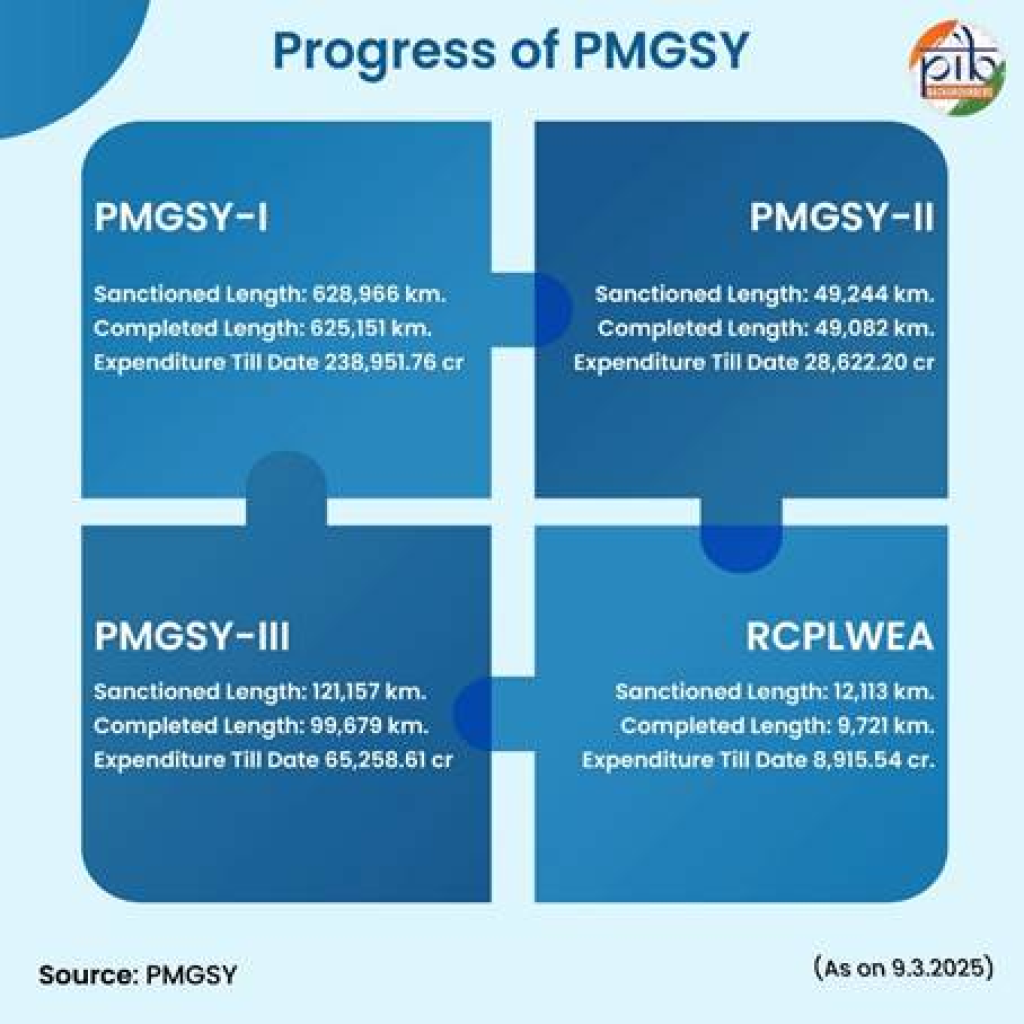
- Phase-I (2000): The flagship initiative aimed at providing all-weather road connectivity to previously unconnected habitations.
- Phase-II (2013): Shifted focus toward upgrading and consolidating existing routes to improve transportation efficiency between rural markets and service hubs.
- RCPLWEA (2016): The road connectivity project for Left Wing Extremism Affected Area (RCPLWEA) is a targeted vertical for 44 districts affected by Left Wing Extremism (LWE).
- It serves a dual purpose: enhancing the mobility of security forces and promoting socio-economic development in underserved regions.
- Phase-III (2019): Focused on upgrading 1,25,000 km of “Through Routes” to link habitations with Gramin Agricultural Markets (GrAMs), hospitals, and higher secondary schools.
- By Dec 2025, 83% of this target (1,01,623 km) was achieved.
- The scheme extends completion timelines till March 2028 for roads and bridges in plain areas and roads in hilly areas, and till March 2029 for bridges in hilly areas.
PMGSY Phase-IV (2024-2029)
- About: Phase IV, launched for the period 2024–25 to 2028–29, aims to provide all-weather road connectivity to 25,000 unconnected rural habitations across India.
- The phase proposes construction of 62,500 km of rural roads with a total financial outlay of Rs 70,125 crore.
- The scheme covers unconnected habitations based on the Census 2011 population criteria, including habitations with a population of 500 and above in plain areas, 250 and above in North-Eastern and Himalayan States/UTs, and settlements located in special category regions such as Tribal (Schedule V) areas, Aspirational Districts/Blocks and desert areas.
- Convergence with Tribal Schemes: PMGSY-IV is intricately linked with the Dharti Aaba Janjatiya Gram Utkarsh Abhiyan and PM-JANMAN to prioritize connectivity for tribal populations.
- Mandatory Green Technology: There is a strict mandate to utilize “Green Technologies” such as waste plastics, cell-filled concrete, fly ash, and cold mix technology to minimize the carbon footprint, particularly in fragile ecosystems like the Himalayas.
- Digital Integration and PM Gati Shakti: The alignment of roads is being mapped using the new PMGSY Gram Sadak Survey App and the PM Gati Shakti portal, ensuring data-driven, detailed project reports (DPRs) and preventing infrastructure overlap.
Application of Advanced Technologies in Rural Road Development
- OMMAS (Online Management, Monitoring, and Accounting System): Provides real-time monitoring of physical and financial progress, integrated with a Project Management Information System (PMIS).
- e-MARG (electronic Maintenance of Rural Roads): Tracks maintenance during the 5-year Defect Liability Period (DLP). Crucially, contractor payments are now directly linked to road performance and quality outcomes.
- GPS-enabled Tracking: Since May 2022, all machinery and vehicles for PMGSY-III works must have a Vehicle Tracking System (VTS) to ensure adherence to prescribed construction processes.
- Carbon Footprint Reduction: Use of Cold Mix technology and Full Depth Reclamation (FDR) reduces the need for heating bitumen and mining fresh stone aggregates.
- Bio-Engineering: Deployment of geosynthetics and bio-bitumen to ensure road stability in flood-prone and mountainous terrains, aligning with the Sustainable Development Goals (SDGs).
National Technology Day 2026
On the occasion of National Technology Day (11th May 2026), the Prime Minister recalled the historic Pokhran nuclear tests of 1998, describing them as a symbol of India’s scientific excellence, strategic capability and self-reliance.
- National Technology Day: Observed every year on 11th May, the day commemorates Operation Shakti (Pokhran-II), where India successfully conducted a series of five nuclear tests in 1998 under the leadership of Prime Minister Atal Bihari Vajpayee and Dr. APJ Abdul Kalam.
- The Operation Shakti showcased India’s scientific strength and reinforced its strategic autonomy in the global order.
- The operation, led by A. P. J. Abdul Kalam, involved successful nuclear tests at the Pokhran Test Range in Rajasthan and followed the earlier Pokhran-I (Operation Smiling Buddha) conducted in 1974.
- On the same day, India also successfully tested the Trishul surface-to-air missile and conducted the test flight of the indigenous aircraft Hansa-3, marking major achievements in defence and aerospace technology.
- After the Pokhran-II nuclear tests in 1998, Prime Minister Atal Bihari Vajpayee declared India a nuclear-weapon state. The first National Technology Day was celebrated on 11th May 1999.
- National Technology Day 2026 Theme: “Responsible Innovation for Inclusive Growth,” highlights ethical and inclusive technological advancement towards Aatmanirbhar Bharat.
- India’s Major Initiatives to Promote Science and Technology: National Quantum Mission, India Semiconductor Mission 2.0, Deep Ocean Mission, Anusandhan National Research Foundation (ANRF), and the Vigyan Dhara Scheme lead India’s technological frontier.
- Additionally, initiatives like Biotech-KISAN, iDEX, and the National Mission on Interdisciplinary Cyber-Physical Systems enhance indigenous scientific capabilities.
SC Launches ‘One Case One Data’ and ‘Su Sahay’
Recently, the Supreme Court launched two major digital initiatives, ‘One Case One Data’ and ‘Su Sahay’, aimed at strengthening digital judicial administration and access to justice.
- One Case One Data: It is a digital integration initiative designed to integrate data from the Supreme Court, High Courts, district courts and taluka courts into a unified digital system.
- The initiative seeks to streamline case management and create a comprehensive, interconnected judicial database across India.
- Su Sahay: ‘Su Sahay’ is an AI-powered chatbot integrated with the Supreme Court website to help litigants and citizens access court-related services easily.
- The chatbot provides front-end guidance and simplifies access to essential Supreme Court services and procedures.
- The chatbot has been developed by the National Informatics Centre (NIC) in collaboration with the Supreme Court Registry.
- Significance: The initiatives promote digitisation, accessibility, efficiency and technology-driven justice delivery while maintaining the importance of human oversight in the legal system.
National Panchayat Awards 2025
Recently, the Ministry of Panchayati Raj announced the National Panchayat Awards 2025, with 42 Panchayats selected from across the country under two categories — Deen Dayal Upadhyay Panchayat Satat Vikas Puraskar and Nanaji Deshmukh Sarvottam Panchayat Satat Vikas Puraskar. Karnataka secured the highest number of awards with 6 winning Panchayats, followed by Andhra Pradesh and Odisha with 5 awards each.
- Deen Dayal Upadhyay Awards: It recognises outstanding Gram Panchayats for their performance across 9 themes of Localisation of Sustainable Development Goals (LSDGs), including poverty-free livelihoods, health, water sufficiency, sanitation, women-friendly governance and social justice.
- Under each LSDG theme, awards are conferred for Rank 1, Rank 2 and Rank 3, with the selection linked to Panchayat Advancement Index (PAI) 2.0 scores.
- A total of 34 Gram Panchayats from 17 States and Union Territories have been selected under this category.
- Nanaji Deshmukh Sarvottam Panchayat Satat Vikas Puraskar: Under this category, awards are given to the best-performing Panchayats at the district, block and gram levels.
- Eight Panchayats have been selected under this category, including three district Panchayats, two block Panchayats and three Gram Panchayats.
National Panchayat Awards
- About: The Ministry of Panchayati Raj annually confers the National Panchayat Awards to recognise and incentivise best-performing Panchayats for inclusive, participatory and sustainable rural development.
- Winning Panchayats receive financial incentives ranging from Rs. 50 lakh to Rs. 5 crore per awardee, depending on tier and category.
- Implementation: The awards are given under the Incentivization of Panchayats (IoP) scheme, a central component of the Centrally Sponsored Scheme of Rashtriya Gram Swaraj Abhiyan (RGSA).
- Revamp & LSDG Alignment: In 2023, the awards framework was revamped and aligned with the nine themes of Localization of Sustainable Development Goals (LSDGs), making assessment more holistic, transparent and data-driven.
- Significance: The awards strengthen Panchayats’ role in achieving Sustainable Development Goals and translating national priorities into grassroots action towards Viksit Bharat@2047.
UIDAI–NFSU Collaboration on Cybersecurity
Recently, Unique Identification Authority of India (UIDAI) and National Forensic Sciences University(NFSU) entered into a structured five-year collaboration in the fields of digital forensics, cybersecurity and advanced technology research.
- Objective: The MoU aims to strengthen cyber resilience across UIDAI’s digital infrastructure, which supports India’s digital identity ecosystem and digital public infrastructure.
- Key Pillars: The collaboration focuses on six strategic pillars, including academic development, information security, forensic infrastructure, cybersecurity support, research in emerging technologies and student outreach.
- UIDAI: The Unique Identification Authority of India is a statutory authority established under the Aadhaar Act, 2016, under the Ministry of Electronics & Information Technology (MeitY).
- It aims to empower Aadhaar holders with a unique digital identity and anytime, anywhere authentication services.
- Aadhaar is a 12-digit biometric identification number issued by the UIDAI, serving as proof of identity and address for residents across India.
- It aims to empower Aadhaar holders with a unique digital identity and anytime, anywhere authentication services.
- NFSU: National Forensic Sciences University is a specialised institution focused on forensic science, cybersecurity and criminal investigation, supporting national capacity building in digital forensics, cyber investigation and emerging security technologies.