
Current Affairs 19th May 2026 Latest Current Affairs 2026
India–Nordic Summit 2026
The Prime Minister of India concluded a highly significant diplomatic tour of the Nordic region, visiting Oslo, Norway, to participate in the 3rd India-Nordic Summit.
- Hosted by Norway, the summit brought together the Prime Minister of India and the leaders of the five Nordic nations (Denmark, Finland, Iceland, Norway, and Sweden) to review bilateral ties and address contemporary global challenges.
Summary
- The 3rd India–Nordic Summit strengthened cooperation in green technology, innovation, trade, maritime security, AI, space, and climate action, while also deepening strategic ties through agreements such as India-EFTA TEPA and the Indo-Pacific Oceans Initiative.
- Despite strong potential, India–Nordic relations face challenges such as geopolitical differences over Russia, strict ESG standards, low trade volume, regulatory barriers, and technology-related concerns, requiring stronger investment, connectivity, and policy coordination.
What are the Key Highlights of the 3rd India-Nordic Summit?
- Strategic Partnership Upgrade: The summit officially elevated the relationship between India and the Nordic nations (Denmark, Norway, Finland, Iceland, and Sweden) to a trusted Green Technology and Innovation Strategic Partnership.
- The collaboration is heavily anchored in shared democratic values, a rules-based global order, and a mutual focus on sustainable development and tech innovation.
- Trade & Economic Integration: The leaders highlighted the implementation of the India-EFTA Trade and Economic Partnership Agreement (TEPA) and the conclusion of the India-EU Free Trade Agreement.
- A major shared objective under TEPA is driving USD 100 billion in investments into India, projected to create one million direct jobs.
- Climate Action & The Blue Economy: Iceland was welcomed as a new member of LeadIT2.0, a public-private platform focused on decarbonizing heavy industries.
- This includes transitioning the shipping industry to low-carbon models and adhering to the Hong Kong Convention for environmentally safe ship recycling.
- Technology, Space & Defense: The summit emphasized democratizing AI, securing 5G/6G infrastructure, and building global AI governance frameworks (building on India’s successful hosting of the AI Impact Summit in 2026).
- Announced a new Framework Agreement between ISRO and the Norwegian Space Agency, as well as a confirmed Swedish payload for India’s upcoming Venus Orbiter Mission (Shukrayaan 1).
- India highlighted that Nordic defense firms can now take advantage of 100% Foreign Direct Investment (FDI) in Indian Defense Industrial Corridors.
- Global Geopolitics & Security:
- UN Reform: The Nordic countries explicitly reiterated their support for India gaining a permanent seat on a reformed UN Security Council and backing its application to the Nuclear Suppliers’ Group (NSG).
- Counter-Terrorism: Strongly condemned cross-border terrorism specifically referencing the 2025 attacks in Pahalgam and New Delhi and committed to disrupting global terror financing channels.
Previous Summits
- 1st India-Nordic Summit: Stockholm, Sweden (2018)
- 2nd India-Nordic Summit: Copenhagen, Denmark (2022)
- Next Destination: The leaders decided that the 4th India-Nordic Summit will be hosted by Finland.
Key Outcomes of India’s Bilateral Engagements With Norway
- Conferment of Top State Honour: PM Narendra Modi was awarded the Grand Cross of the Royal Norwegian Order of Merit by King Harald V, which is Norway’s highest civilian honour bestowed on foreign heads of government.
- Maritime Security Dialogue: India and Norway officially instituted a dedicated Maritime Security Dialogue.
- This framework aims to enhance information sharing, inter-agency coordination, and tackle Illicit Maritime Activities (IMA) such as piracy, smuggling, and illegal fishing.
- Sovereign Investment Corridor: The leaders actively discussed creating a “Sovereign Investment Corridor.”
- It is designed to directly channel patient capital from Norway’s massive sovereign wealth fund (one of the world’s largest) into India’s long-term green infrastructure and renewable energy projects.
- It bypasses traditional, slower foreign portfolio investment routes by offering a state-backed guarantee of ease of doing business.
- Expansion of the Indo-Pacific Oceans Initiative (IPOI): In a major strategic move, Norway formally joined India’s IPOI.
- This signals a growing European alignment with India’s vision for a free, open, and prosperous Indo-Pacific region, expanding ties beyond the economic realm into maritime security.
Other Key Bilateral Engagements
- Finland: India and Finland elevated bilateral ties to a Strategic Partnership in Digitalization and Sustainability.
- Both sides agreed to deepen cooperation in AI, 5G/6G, quantum technologies, renewable energy, innovation, and circular economy, while reaffirming their commitment to doubling bilateral trade by 2030 and jointly hosting the World Circular Economy Forum in Gujarat in September 2026.
- Denmark: India and Denmark reviewed progress under the India–Denmark Green Strategic Partnership launched in 2020.
- Both sides agreed to strengthen cooperation in climate action, green transition, AI, defence, advanced research, and start-ups.
Nordic Region
- Geographical Composition: The region consists of Denmark, Finland, Iceland, Norway, and Sweden, alongside three autonomous territories: the Faroe Islands and Greenland (associated with Denmark) and the Åland Islands (associated with Finland).
- Nordic vs. Scandinavia: Though frequently used interchangeably, Scandinavia is a more restrictive geographic term referring primarily to Denmark, Norway, and Sweden, whereas “Nordic” encompasses the broader five-nation group and its territories.
- Regional Demographics: Within this bloc, Sweden stands as the largest and most populous country, while Denmark is the smallest in landmass and Iceland is the least populous.
- Socio-Economic Benchmarks: The region is globally renowned for the “Nordic Model,” consistently ranking at the top of international indices for education, civil liberties, quality of life, and economic competitiveness.
- Diverse Political Structures: The region splits its governance styles; Denmark, Sweden, and Norway are constitutional monarchies and parliamentary democracies, while Finland and Iceland function as democratic republics.
- Institutional Governance: Inter-governmental and parliamentary cooperation is formally maintained through the Nordic Council and the Nordic Council of Ministers.
- The Nordic Council is the official body for cooperation among Nordic countries, established in 1952. It promotes regional cooperation, improves the lives of Nordic citizens, and addresses shared challenges such as climate change, sustainability, security, and digital transformation.
- Finland holds the Presidency of the Nordic Council for 2026. Its Secretariat is located in Copenhagen.
- India is the only country besides the US to have summit-level ties with the Nordics collectively.
- Overlapping European Alignments: The countries differ in their integration with continental bodies:
- Denmark, Sweden, and Finland are members of the European Union (EU).
- Norway and Iceland are not EU members but participate via the European Economic Area (EEA) and the European Free Trade Association (EFTA).
Nordic-Baltic Eight
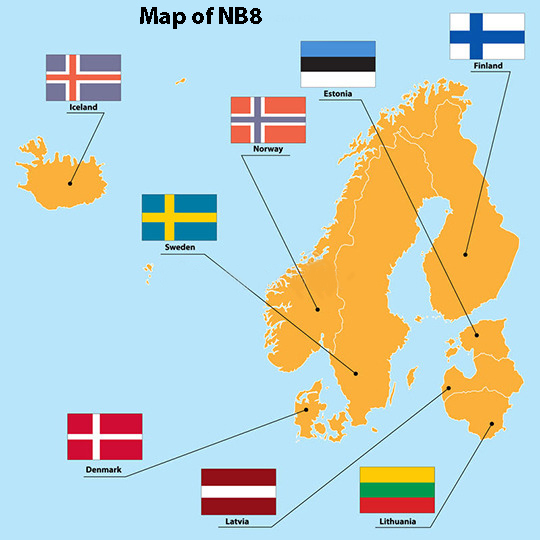
- Nordic-Baltic Eight (NB8) is an informal coalition that unites five Nordic and three Baltic nations (Estonia, Latvia, Lithuania) to foster strategic regional collaboration.
- Within the group, the six EU member states (excluding Iceland and Norway) convene under the NB6 format to coordinate EU-specific policies.
- Currently chaired by Estonia for 2026, the NB8 is increasingly prioritizing its strategic partnership with India.
- This alignment was highlighted during the 2023 CII India Nordic-Baltic Business Conclave, which focused on deepening bilateral cooperation across innovation, green technology, maritime affairs, and space exploration.
Significance of the Nordic Region for India?
- The “Innovation-Scale” Synergy: The Nordic countries consistently rank at the top of global innovation, digitalization, and sustainability indices.
- Sweden, Finland and Denmark are among the world´s top ten most innovative economies according to the World Intellectual Property Organization (WIPO).
- They possess capital, IP, and advanced R&D. India offers a massive data pool, demographic scale, and a booming market, creating a perfect complementary synergy.
- Arctic-Indo-Pacific Interlinkage: As the Arctic ice melts, opening new sea routes and access to critical minerals, the geopolitical theatre is expanding.
- India, an Observer in the Arctic Council, views the Nordic nations as crucial partners for polar research (e.g., India’s Himadri station in Svalbard, Norway), climate monitoring, and securing its strategic interests in the High North.
- Defense Industrial Base Expansion: The 100% FDI is now available for Nordic defense firms within the Indian Defence Industrial Corridors (e.g., UP and Tamil Nadu nodes).
- This aligns with India’s Atmanirbhar Bharat push in defense manufacturing.
- Pioneering the Circular Economy: The Nordic model of circular economy, bioeconomy, and plastic pollution management (aligning with UNEA Resolution 5/14) provides a scalable template for India’s Mission LiFE (Lifestyle for Environment).
- Global Supply Chain Resilience: The partnership is critical for integrating the NB8 region into the India-Middle East-Europe Economic Corridor (IMEC), providing an alternative to China’s Belt and Road Initiative (BRI).
Captagon and Himachal Pradesh’s Anti-heroin Model
The Narcotics Control Bureau (NCB) has intensified its crackdown on transnational drug syndicates, culminating in Operation RAGEPILL, which resulted in India’s first-ever seizure of the psychotropic substance Captagon.
- The agency arrested the kingpin of an India-Myanmar drug network in Delhi and promoted Himachal Pradesh’s ‘anti-heroin’ model, highlighting India’s shift from local policing to targeting transnational narcotics networks.
What is the Captagon?
- About: Captagon is a highly addictive psychotropic substance and central nervous system (CNS) stimulant.
- Chemical Composition & Origin: Captagon was originally the brand name for Fenethylline, a synthetic stimulant developed in the 1960s to treat conditions like ADHD, narcolepsy, and depression.
- Modern Illicit Form: The illicit Captagon circulating now is a clandestine cocktail of amphetamines, methamphetamine, caffeine, and other chemical fillers.
- Geopolitics & Aliases:
- The “Jihadi Drug”: It earned this moniker (along with “Captain Courage”) because it is heavily consumed by extremist and militant groups, such as ISIS, in conflict zones.
- Physiological Effects: Fighters use it to induce a state of euphoria, block out trauma, stay awake for days, and completely suppress fear, fatigue, and hunger.
- “Poor Man’s Cocaine”: It is widely abused across the Middle East (especially in Saudi Arabia and the Gulf states) as a cheap recreational drug.
- Production Hub: Syria is currently recognized as the global epicenter for illicit Captagon production, with the trade forming a multi-billion-dollar shadow economy that heavily funds regional conflicts.
- Legal & Regulatory Status:
- International Ban: Due to its high potential for abuse, Captagon was banned in most countries in the 1980s.
- It is tightly regulated under Schedule II of the UN Convention on Psychotropic Substances, 1971.
- The International Narcotics Control Board (INCB) stated that legitimate industrial manufacture of fenetylline (Captagon) ceased globally in 2009
- Status in India: It is illegal and regulated under the Narcotic Drugs and Psychotropic Substances (NDPS) Act, 1985.
- International Ban: Due to its high potential for abuse, Captagon was banned in most countries in the 1980s.
Narcotics Control Bureau (NCB)
- The NCB is the nodal drug law enforcement and intelligence agency under the Ministry of Home Affairs, Government of India.
- It was constituted on 14th November 1985 under the provisions of the Narcotic Drugs and Psychotropic Substances (NDPS) Act, 1985, with its headquarters in New Delhi.
- The NCB coordinates with Central and State agencies on drug law enforcement, assists states in strengthening anti-drug measures, collects and disseminates intelligence, analyses seizure trends and modus operandi, and prepares national drug enforcement statistics.
What is Himachal Pradesh’s ‘Anti-heroin’ Model?
- About: Himachal Pradesh’s ‘anti-heroin’ model, locally known as the ‘Anti-Chitta’ model, is a comprehensive, multi-pronged strategy developed by the state government to eradicate the growing menace of heroin (chitta) trafficking and addiction.
Key Pillars
- Panchayat-Level Mapping and Zoning: Himachal Pradesh became the first state in India to map drug addicts and traffickers at the grassroots (panchayat) level.
- Through a statewide survey, the government categorized areas into Red, Yellow, and Green zones based on the severity of drug prevalence, allowing law enforcement to concentrate their surveillance and resources exactly where they are needed most.
- Strict Enforcement and Asset Seizure: The state has aggressively invoked the Prevention of Illicit Traffic in Narcotic Drugs and Psychotropic Substances (PIT-NDPS) Act 1988, leading to the confiscation of illegal properties worth over Rs 51 crore linked to drug traffickers.
- Mandatory drug testing for chitta has even been introduced for police recruitment to ensure the integrity of law enforcement.
- Anti-Chitta Volunteer Scheme and Community Action: The state launched an initiative to engage over 1,000 Anti-Chitta Volunteers across the state.
- These volunteers operate confidentially to provide ground-level intelligence, report hotspots, and identify offenders to the police.
- Drug prevention committees have been formed at the panchayat level to submit regular reports to law enforcement and conduct awareness drives in schools and communities.
- Focus on Rehabilitation: Instead of just treating addicts as criminals, the model heavily emphasizes victim recovery.
- The state is developing modern rehabilitation centers in collaboration with top medical and policy institutions, including NITI Aayog, AIIMS Delhi, and PGIMER Chandigarh. These centers are being set up in districts like Sirmaur, Shimla, and Kangra to help affected youths integrate back into society.
- By combining aggressive financial crackdowns on suppliers with compassionate, community-driven help for addicts, Himachal Pradesh has created a blueprint that tackles both the supply and demand sides of the drug trade.
SC Allows Euthanasia of Rabid and Dangerous Stray Dogs
The Supreme Court of India has permitted civic authorities to take legally permissible measures, including euthanasia, for rabid, incurably ill, or aggressively dangerous stray dogs in accordance with the Animal Birth Control (ABC) Rules, 2023.
- Strict Ban on Street Feeding: The bench upheld its previous directives banning the feeding of stray dogs on public streets, requiring local bodies to allot dedicated feeding spots instead.
- Article 21 (Right to Life): The Court ruled that it casts an affirmative, non-negotiable duty on the State to secure citizens against threats to life and safety arising from stray dog attacks.
- Article 19(1)(d) guarantees citizens the right to move freely. The Court observed that unchecked stray dog populations in public spaces can violate this fundamental right.
- However, animal welfare groups relied on Article 51A(g) of the Constitution, which places a fundamental duty on citizens to show compassion towards living creatures.
- Mandatory District ABC Infrastructure: Every State and Union Territory must establish at least one fully functional Animal Birth Control (ABC) centre in each district, equipped with surgical facilities, supporting logistics, and trained veterinary personnel.
- Clearing High-Footfall Public Areas: The Court ordered the strict implementation of previous directives regarding the removal of free-ranging dogs from public utilities, schools, hospitals, and high-density transit zones to ensure a secure environment.
- Public Health Response Mandate: States must ensure unhindered and adequate availability of anti-rabies vaccines and immunoglobulin across all government healthcare facilities to manage dog-bite cases effectively.
- Highway Safety Mechanism: The National Highways Authority of India (NHAI) has been directed to formulate a time-bound mechanism using specialized transport vehicles to safely handle and relocate stray cattle and animals from national highways and expressways.
- Legal Immunity for Implementing Officers: To facilitate strict implementation, the Court granted administrative officers protection from FIRs or criminal proceedings for bona fide actions taken under these directives, unless a prima facie case of malice or gross abuse of authority is established.
- Roots in Institutional Failure: The judgment took note of a continuous institutional failure at the municipal level to implement the Animal Birth Control Rules since 2001, which allowed the free-roaming dog population to swell significantly.
Animal Birth Control (ABC) Rules, 2023
- The ABC, 2023, issued under the Prevention of Cruelty to Animals Act, 1960, treats sterilisation and anti-rabies vaccination as the primary way to control stray dog populations.
- They also require dogs to be released back into the same locality after sterilisation, recognising that stray dogs are territorial by nature.
- The Rules do not permit indiscriminate killing or relocation of dogs. Euthanasia is allowed only in limited situations involving rabid, terminally ill or fatally injured animals.
DRDO Successfully Tests ULPGM-V3 Missile
Recently, the Defence Research and Development Organisation (DRDO) successfully conducted flight trials of the Unmanned Aerial Vehicle Launched Precision Guided Missile (ULPGM-V3) at the National Open Area Range (NOAR), Kurnool, Andhra Pradesh.
- The missile was tested in both Air-to-Ground and Air-to-Air modes from an indigenous UAV developed by NewSpace Research Technologies, with support from DRDO labs, and 30 MSMEs/start-ups.
ULPGM- V3
- About: ULPGM-V3 is a drone-launched precision missile that can accurately hit both ground targets and enemy aerial targets.
- Its Air-to-Ground role is mainly for destroying tanks, while its Air-to-Air role is for targeting drones, helicopters and other airborne threats.
- It is an upgraded version of DRDO’s ULPGM-V2, enhancing India’s indigenous drone-launched precision strike capability.
- Objective: The recent trials were carried out in the Anti-armour configuration, designed to neutralise modern armoured vehicles protected by Rolled Homogeneous Armour (RHA) and Explosive Reactive Armour (ERA).
- Key Features:
- Precision Targeting: ULPGM-V3 is equipped with a high-definition dual-channel seeker, enabling precise engagement of a wide variety of targets.
- All-Weather Capability: The missile features full day-and-night operational capability, ensuring effectiveness under varying visibility conditions.
- Terrain Flexibility: It is designed for deployment in both plain terrains and high-altitude regions, enhancing operational versatility.
- Real-Time Guidance: It supports two-way real-time data transmission, allowing post-launch target updates and mid-course aim-point corrections.
- Anti-Bunker Role: The Penetration-cum-Blast warhead is optimised for destroying fortified structures and bunker targets.
- Warhead Options: The missile has three modular warhead configurations:
- Anti-armour warhead for modern armoured vehicles equipped with RHA and ERA
- Penetration-cum-Blast warhead for anti-bunker applications
- Pre-fragmentation warhead with high lethality effects.

