India celebrated National Panchayati Raj Day (NPRD) on 24th April 2026, commemorating the enactment of the 73rd Constitutional Amendment Act, 1992, which granted constitutional status to Panchayati Raj Institutions (PRIs), marking 33 years of this defining milestone in India’s democratic journey.
National Panchayati Raj Day
- Historical Background: The day commemorates the institutionalization of the Panchayati Raj system in India through the 73rd Constitutional Amendment Act, 1992.
- The Act came into force on 24th April 1993, marking a defining moment in the history of decentralized political power in India.
- First Celebration: The first National Panchayati Raj Day was celebrated in 2010 under the leadership of then-Prime Minister Manmohan Singh.
- Objective: To assess the progress of rural decentralization, interact with Gram Panchayat representatives, and recognize their outstanding contributions to rural development.
- Theme for NPRD 2026: The theme, “Sashakt Panchayat, Sarvangeen Vikas” (Empowered Panchayats, Holistic Development), focuses on localising Sustainable Development Goals (SDGs) and strengthening digital governance through e-Gram Swaraj to achieve the vision of “Viksit Bharat” by 2047.
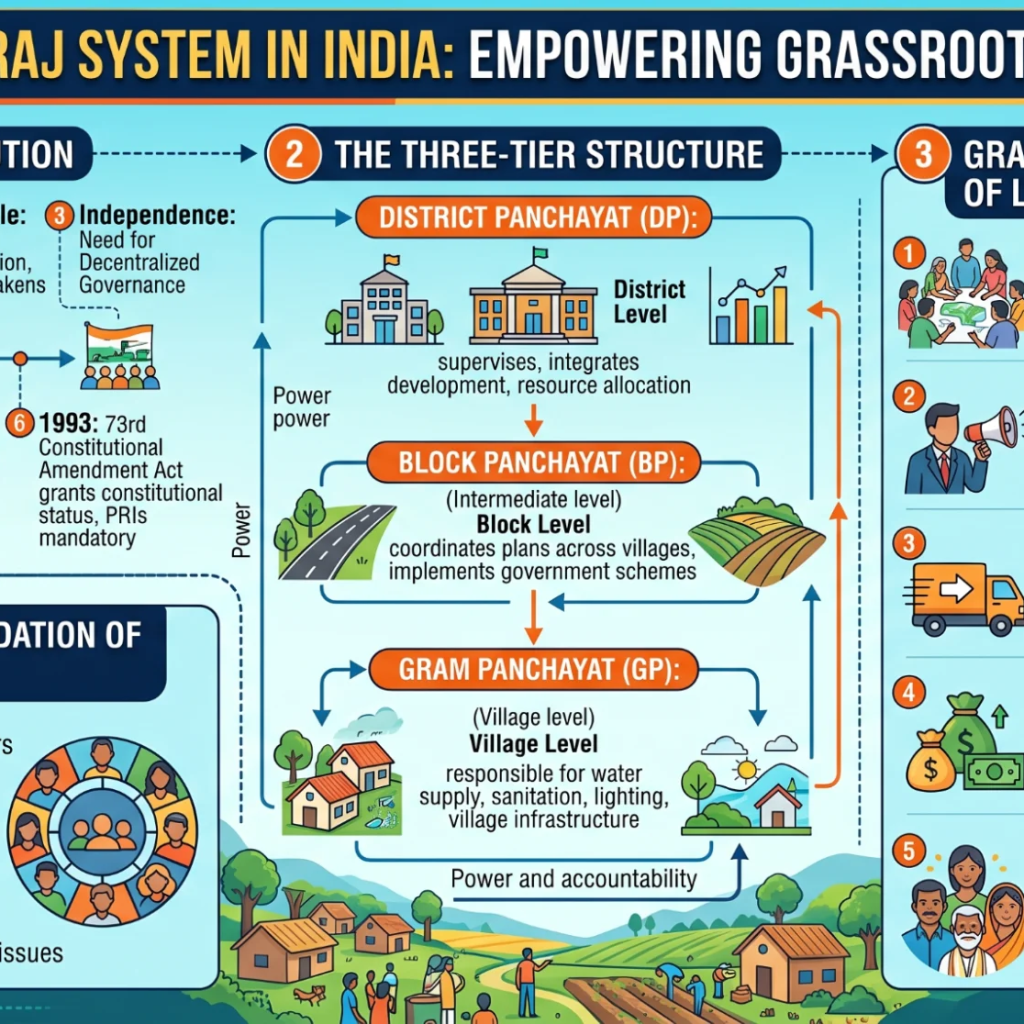
Key Provisions of the 73rd Constitutional Amendment Act (1992)?
- Structural Additions to the Constitution: The 73rd CAA fundamentally altered India’s federal structure by shifting it from a two-tier system (Centre and States) to a multi-level decentralized architecture, providing “practical shape” to Article 40 (Directive Principles of State Policy).
- Part IX: Inserted Articles 243 to 243-O, explicitly detailing the mechanics of rural local self-government.
- Eleventh Schedule: Added to enumerate 29 functional items (e.g., land improvement, minor irrigation, rural electrification) designated for devolution to Panchayati Raj Institutions (PRIs) under Article 243G.
- Institutionalization of Participatory Democracy: India has over 2.5 lakh Panchayats and 24.04 lakh elected representatives. Remarkably, women make up 49.75% of these representatives.
- Gram Sabha (Article 243A): Established as the foundational unit. Unlike the elected Panchayat, the Gram Sabha consists of all registered voters in a village, making it the only forum of direct, participatory democracy in the Indian constitutional scheme.
- Three-Tier Architecture (Article 243B & 243C): Mandated a uniform three-tier system: Village, Intermediate (Block/Mandal), and District levels.
- The Demographic Exception: States with a population under 20 lakhs are exempt from establishing the intermediate tier, preventing bureaucratic bloat in smaller states.
- Electoral Mechanics: All members at all three levels are chosen by direct election.
- However, to maintain structural cohesion, the chairpersons at the intermediate and district levels are elected indirectly from amongst the elected members.
- Demographic Equity & Reservations (Article 243D):
- SC/STs: Reservation is strictly proportional to their demographic share in the Panchayat area across all three tiers.
- Women’s Quota: A non-negotiable minimum of 33% (one-third) of all seats and chairperson offices must be reserved for women.
- This includes a one-third sub-quota within the SC/ST reserved seats.
- Tenure Security and Dissolution Guardrails (Article 243E): Fixed a rigid five-year term.
- If a Panchayat is prematurely dissolved, elections must occur before the expiration of a six-month period.
- A reconstituted Panchayat operates only for the unexpired remainder of the dissolved body’s term, preventing states from manipulating dissolution to reset election cycles.
- If the remainder is less than six months, elections are not mandatory.
- Creation of Independent State-Level Watchdogs
- State Election Commission (Article 243K): Vested with the superintendence, direction, and control of electoral rolls and the conduct of PRI elections. To ensure autonomy, the State Election Commissioner has security of tenure equivalent to a High Court Judge.
- State Finance Commission (Article 243-I): Mandated every five years to review PRI finances, recommend tax distribution between the State and Panchayats, and determine grants-in-aid, thereby institutionalizing financial devolution.
Challenges facing the Panchayati Raj Institutions (PRIs)?
Fiscal Strangulation: The “Dependency Trap”
- Dismal Own Source Revenue (OSR): According to the RBI’s 2024 report on ‘Finances of Panchayati Raj Institutions’, PRIs generate a mere 1.1% of their total revenue from local taxes and fees.
- The Ministry of Panchayati Raj (MoPR) expert committee data further reveal that the national average for per capita OSR collected by Panchayats is a negligible Rs 59 annually.
- Overwhelming Grant Dependency: Approximately 95% of Panchayat revenue comes from higher tiers of government (roughly 80% from Central grants and 15% from State grants).
- In states with low OSR, like Uttar Pradesh and Madhya Pradesh, this dependency crosses 95%.
- The “Tied Funds” Constraint: While the 15th Finance Commission awarded substantial funds to Rural Local Bodies, 60% of these are “tied grants” (mandated strictly for sanitation, drinking water, etc.).
- This strips Gram Panchayats of the autonomy to prioritize local, context-specific developmental needs.
- Reluctance and Ambiguity in Taxation: Even where legally empowered, PRIs hesitate to levy property or water taxes due to proximity to voters (fear of political backlash).
- Furthermore, state laws often lack clarity on property valuation, rate revision, and taxation definitions, severely hindering OSR collection.
Administrative and Functional Erosion
- Incomplete Activity Mapping: State governments frequently devolve subjects on paper but retain control over the actual budgeting and operational frameworks.
- Essential services (like solid waste management and drinking water) are managed by state line departments, meaning PRIs cannot levy user charges for them.
- Proliferation of Parallel Bodies: State governments frequently bypass PRIs by creating Special Purpose Vehicles (SPVs), parastatals, or line-department committees for executing schemes (e.g., rural infrastructure projects).
- This fragments local governance and erodes the constitutional authority of the Gram Panchayat.
- Resource Deficit over CPRs: Common Property Resources (CPRs) like forests, grazing lands, and local water bodies remain largely under the control of state line departments, cutting off a vital potential revenue stream for Gram Panchayats.
Institutional and Structural Bottlenecks
- Defunct State Finance Commissions (SFCs): Article 243-I mandates the constitution of SFCs every five years to formalize revenue-sharing between the state and PRIs.
- However, SFCs are routinely delayed, severely under-resourced, and their recommendations are frequently rejected or ignored by State Legislatures.
- Human Resource and Capacity Deficit: PRIs suffer from a severe shortage of technical and administrative staff (e.g., accountants, engineers).
- Overburdened Panchayat officials lack the training required for complex tasks like tax assessment, spatial planning, and digital auditing via eGramSwaraj.
- Social and Proxy Representation: The pervasive “Sarpanch Pati” syndrome—where male relatives wield the actual executive power on behalf of elected women representatives—continues to undermine the 33% reservation mandate (Article 243D) and stifles genuine grassroots gender empowerment
India’s Initiatives Related to PRIs
- SVAMITVA Scheme: Launched in April 2021, it uses drones and Geographical Information System (GIS) to map inhabited village areas and issue property cards.
- As of March 2026, surveys are complete in 3.29 lakh villages, and 2.65 crore property cards have been distributed.
- SabhaSaar: An AI-powered tool integrated with Bhashini that automatically transcribes and structures Gram Sabha meeting minutes in 23 regional languages. It is currently used by over 1 lakh Gram Panchayats.
- eGramSwaraj: A portal available in 22 languages for planning, financial management, and real-time payments and it is linked with the Public Financial Management System.
- Gram Urja Swaraj: A dashboard tracking renewable energy assets in real-time. It monitors solar, hydel, wind, and biogas usage across 2,080 Gram Panchayats.
- Meri Panchayat App: An m-Governance platform developed by NIC to improve citizen participation and accountability, aligned with the Sustainable Development Goals (SDGs).
- Rashtriya Gram Swaraj Abhiyan (RGSA): A scheme designed to build leadership and governance capabilities to meet SDGs.
- Model Women-Friendly Gram Panchayat (MWFGP): An initiative under SDG Theme 9 aiming to develop one model women-friendly Panchayat per district, focusing on safety, rights, and inclusive governance.
- Sashakt Panchayat–Netri Abhiyan: A special interactive training module that has trained around 1.5 lakh Elected Women Representatives (EWRs) to enhance their leadership, communication, and negotiation skills.
- Model Youth Gram Sabha (MYGS): A program engaging Class 9 and 10 students from Jawahar Navodaya Vidyalayas and Eklavya Model Residential Schools in mock Gram Sabhas to foster participatory democracy among the youth.
- Increased Finance Grants: Funding for Rural Local Bodies jumped from Rs 2.36 lakh crore under the 15th Finance Commission (2021–26) to nearly Rs 4.35 lakh crore under the 16th Finance Commission (2026–31).
- Grants are categorized into “untied” (for local needs) and “tied” (for basic services like water and sanitation) to balance flexibility with accountability.
- Union Budget allocations for rural development have spiked by over 211% in the last decade, reaching Rs 2.73 lakh crore for 2026–27.
- Funds are successfully converging with major initiatives like the Viksit Bharat- G RAM G Act, 2025, Jal Jeevan Mission, and Swachh Bharat Mission to drastically improve rural infrastructure.