Seven former MPs of the Aam Aadmi Party joined the Bharatiya Janata Party and have cited the “merger” provision under the anti-defection law to avoid disqualification.
- This has raised constitutional questions on whether a legislature party alone can claim a valid merger without the involvement of the original political party.
What is Anti-Defection Law?
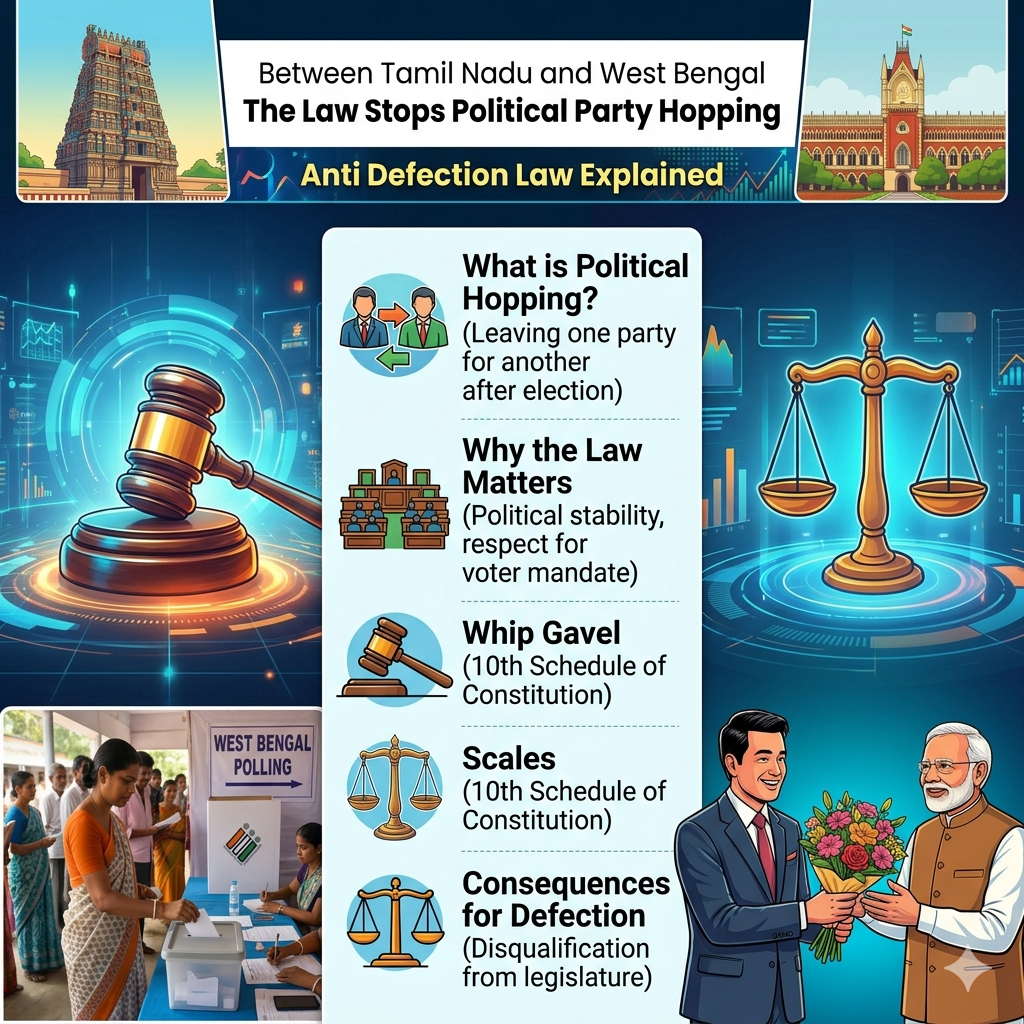
- About: The Anti-Defection Law is a set of rules in the Indian Constitution designed to prevent elected politicians (Members of Parliament or State Legislative Assemblies) from switching political parties for personal gain or political maneuvering.
- It was introduced to bring stability to the parliamentary system and stop the infamous “Aaya Ram, Gaya Ram” culture of the 1960s and 70s, where legislators frequently changed sides, causing governments to collapse.
- Between 1967 and 1972, nearly 2,000 cases of defection occurred, with about 50% of legislators switching parties, some multiple times.
- It was introduced to bring stability to the parliamentary system and stop the infamous “Aaya Ram, Gaya Ram” culture of the 1960s and 70s, where legislators frequently changed sides, causing governments to collapse.
- It was added to the Constitution by the 52nd Amendment Act in 1985, which created the Tenth Schedule.
- The law was strengthened by the 91st Constitutional Amendment Act, 2003, which omitted the provision related to a “split” (where 1/3rd members could defect) and retained only the “merger” provision.
- It was introduced to bring stability to the parliamentary system and stop the infamous “Aaya Ram, Gaya Ram” culture of the 1960s and 70s, where legislators frequently changed sides, causing governments to collapse.
- Grounds for Disqualification:
- Voluntarily giving up membership: If an elected member formally resigns from the political party on whose ticket they were elected.
- The Supreme Court has ruled that “voluntarily giving up” can be inferred from a member’s conduct, even without a formal resignation.
- Defying the Party Whip: If a member votes, or abstains from voting, in the House contrary to the directions issued by their political party, without obtaining prior permission.
- Independent Members: If a member elected as an “Independent” candidate joins any political party after the election.
- Nominated Members: If a nominated member (who is not elected but appointed) joins a political party after six months of taking their seat in the House.
- Voluntarily giving up membership: If an elected member formally resigns from the political party on whose ticket they were elected.
- Exceptions to Disqualification:
- The ‘Merger’ Clause: If a political party merges with another party, and at least two-thirds of the legislators of that party agree to the merger, they are protected from disqualification.
- To claim protection under the ‘Merger’ Clause of the Anti-Defection Law (Paragraph 4 of the Tenth Schedule), a specific “Twin Test” must be strictly satisfied. It is not enough for legislators to simply switch sides in large numbers.
- Test One (The Origin): There must be a formal merger of the original political party (the broader organizational entity) with another political party.
- Test Two (The Numbers): Following that party-level merger, at least two-thirds of the members of its legislature party (the elected MPs or MLAs in the House) must agree to and adopt the merger.
- The act of merging must originate from the political party itself. A group of elected legislators cannot independently engineer a merger solely to ward off anti-defection proceedings.
- To claim protection under the ‘Merger’ Clause of the Anti-Defection Law (Paragraph 4 of the Tenth Schedule), a specific “Twin Test” must be strictly satisfied. It is not enough for legislators to simply switch sides in large numbers.
- The ‘Merger’ Clause: If a political party merges with another party, and at least two-thirds of the legislators of that party agree to the merger, they are protected from disqualification.
- Presiding Officers: If a member is elected as the Speaker or Chairman of the House, they can resign from their political party to maintain neutrality in their role, and they will not be disqualified.
- They can rejoin their party after their tenure ends.
- Role of the Presiding Officer: The power to decide on questions of defection lies exclusively with the Presiding Officer of the House- the Speaker in the Lok Sabha/Legislative Assemblies, and the Chairman in the Rajya Sabha/Legislative Councils.
Judicial Pronouncements Regarding Anti-Defection
- Padi Kaushik Reddy v. State of Telangana (2025): SC urged Parliamentary reforms to ensure timely and fair adjudication of defection cases and re-examine the Speaker’s role.
- Subhash Desai vs Principal Secretary Governor of Maharashtra (2023): SC held that the original political party and the legislature party are separate entities, and clarified that a legislature party can claim protection from disqualification only when a merger is initiated by the original political party, not on its own.
- Keisham Meghachandra Singh vs The Hon’ble Speaker, Manipur Legislative Assembly (2020): Speaker must decide disqualification cases within 3 months; delays defeat the Tenth Schedule.
- SC also suggested an independent tribunal to ensure neutrality and speed.
- Ravi S. Naik v. Union of India (1994): Speaker must act as a neutral adjudicator, an MP/MLA can be disqualified without formally resigning if conduct shows defection.
- Kihoto Hollohan v. Zachillhu (1992): Speaker’s decisions under the Anti-Defection Law are subject to judicial review in cases of mala fide intent, procedural irregularity, or constitutional violation.